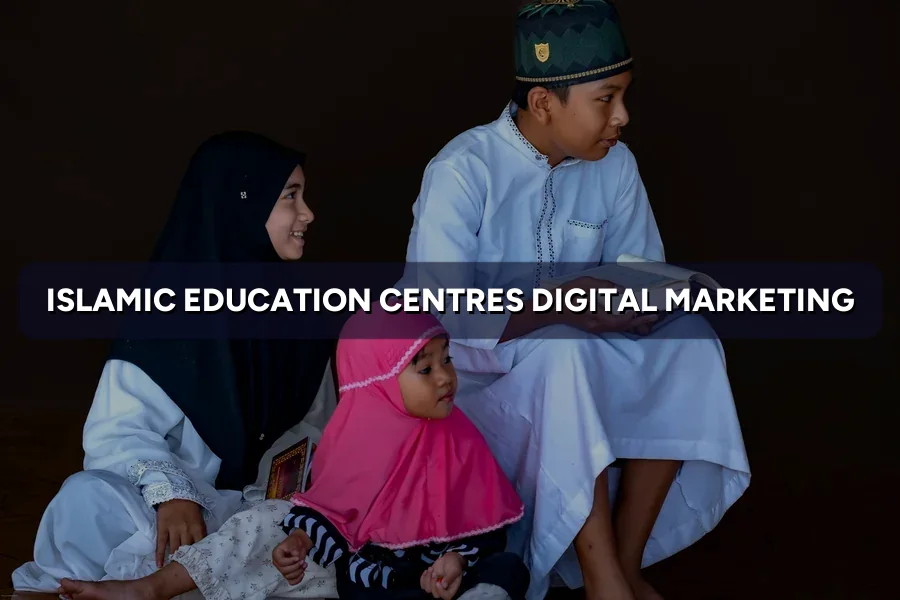
A father opens your Facebook page at eleven at night. He has a seven-year-old, a sister-in-law who mentioned your name, and one question he cannot find an answer to: is this place registered, and will his son still sit SPM.
Most school marketing advice comes from markets with open enrolment periods and admissions teams. That is not how a Malaysian sekolah agama or maahad tahfiz fills a class. Here one aunt’s recommendation outweighs a month of advertising — and the parent who arrives recommended still checks you online first.
If you run a sekolah agama, a maahad tahfiz, an integrated Islamic school or a KAFA centre, this guide applies the IZI Blueprint — the four-phase method we use in consulting engagements — to digital marketing for Islamic education centres. It starts where the parent starts: with trust.
How independent schools grow enrolment without discounting
Source video: How to Increase Enrollment in Independent Schools
PART 2 · THE MARKET
What Malaysia’s Islamic Education Sector Looks Like in 2026
IN BRIEFOrganised, counted, and getting more formal every year. More than 1,400 registered tahfiz institutions now teach over 61,000 pupils, and a national recognition standard began rolling out in 2026 — which changes what parents expect to see across the sectors we advise.
At the December 2025 launch of the Standard Pengiktirafan Tahfiz Malaysia, the Deputy Prime Minister put the registered ecosystem at 1,401 tahfiz institutions, 10,081 asatizah and 61,494 pupils, according to Bernama. That is the visible half of the market. The other half is families still deciding whether to move a child at all.
- The register is a marketing asset. Parents can look you up themselves, so being listed is proof, not paperwork.
- Standards are tightening. The same announcement confirmed SPTM would roll out in stages from 2026, covering governance, premises, curriculum and teacher quality.
- Geography shapes demand. You serve the families who can realistically do the school run, which makes catchment matter more than reach.
- Your real competitor is inertia. Most parents who consider a religious school never switch, because nobody answered the SPM question clearly.
PART 3 · DIAGNOSE
How Malaysian Parents Choose an Islamic School
IN BRIEFA recommendation first, then months of quiet verification. The shortlist forms differently from the way parents pick a kindergarten, because this decision is about a child’s whole upbringing rather than a convenient half-day.
Four steps, and the gap between the first and the last is often a full year.
- Someone they trust names you. A relative, a surau circle, a colleague. Almost nobody starts this search cold on Google.
- They verify you privately. Registration, asatizah, curriculum, fees, examinations. On a phone, at night, without telling anyone yet.
- They compare two or three. Rarely more, and rarely on price. The comparison is about whether the academic side is real.
- They visit, then decide. One visit, usually both parents, usually near the deadline. It confirms or destroys what your pages promised.
Plenty of enquiries, very few open-day visits?
That gap is almost never an advertising problem — it is usually what your pages fail to say about registration, asatizah and the academic stream. Meet IZI Digital Marketing
PART 4 · DIAGNOSE
Where Islamic Schools Lose Parents Before the Visit
IN BRIEFSix leaks, and an unanswered academic question is the costliest. The slow-reply problem is the one that also drains enquiries from a language centre, except here the parent has been thinking for months and will not chase you twice.
Open your own pages on a phone, late at night, and read them as a cautious father would.
- Registration nowhere in text. The one claim an unregistered operator cannot copy, and most schools bury it in a photograph.
- The examination question left hanging. Whether pupils sit national assessments, SPM or a tahfiz pathway decides the enrolment.
- Asatizah unnamed. “Guru berpengalaman” tells a parent nothing. Names and qualifications do.
- No fee figures at all. A parent budgeting a full year cannot plan around “hubungi kami”, so she moves to the school that published a range.
- No daily timetable. Parents want to picture the day — hafazan, academic hours, rest, sport. Without it they imagine the worst.
- A reply three days later. These messages arrive at night and at weekends. Silence reads as disorganisation.
PART 5 · DESIGN
Which Channel Deserves Your First Ringgit?
IN BRIEFThe one that reaches families already inside your catchment. For most Islamic schools that means local search and the map listing before anything paid, because a daily school run rules out most of the state.
Four criteria settle it: speed to a booked visit, cost at the floor, how well the channel carries a decision built on trust, and how much of your week it eats. That third one is what generic school-marketing advice ignores.
DECISION BOX · FIRST CHANNEL FOR AN ISLAMIC SCHOOL
| Option | Speed to a booked visit | Monthly floor | Carries a trust decision | Your time |
|---|---|---|---|---|
| Business Profile, school pages and parent reviews | 4–10 weeks | RM 0–500 | Very well — you control every word | Low, but never stops |
| Search ads on registration and tahfiz terms | Days | RM 1,200+ | Good — the parent is already looking | Low once set up |
| Meta ads to parents within the catchment | Days | RM 1,000+ | Only with real classroom footage | Medium — needs fresh material |
| Surau, mosque and alumni-parent referrals | One enrolment cycle | Time, not ringgit | Best of all — trust travels with it | High and personal |
Verdict: Publish the registration, the asatizah and the fee range first — nothing paid converts without them. Then choose search ads if families in your district are already searching and picking somebody else, or the surau and alumni network if you are new, small, or short of search volume. Doing both on a first budget means doing neither properly.
Volume is the trap. Religious-school search terms in one district can be thin enough that a loose campaign spends most of its budget on readers three states away.
PART 6 · DESIGN
Setting a Budget From One Pupil’s Full Fee Journey
IN BRIEFBudget against the whole journey, not one term. A pupil who stays six years is worth many times a single enrolment — the same arithmetic that governs budgeting at a childcare centre, over a far longer horizon.
Five numbers, in this order.
- Take your real average monthly fee. What families actually pay after sibling discounts and assisted places, not the rate card.
- Multiply by months attended across the full stay. Pull your leavers’ data. Most schools underestimate average length of stay badly.
- Deduct the cost of teaching that pupil. Asatizah hours, meals, transport, premises. What remains is what one family is worth.
- Set an affordable cost per enrolment. Pick the share of first-year fees you will pay, then divide by your visit-to-enrolment rate.
- Cap the spend at your empty seats. Advertising past capacity buys a waiting list, and waiting lists send families down the road.
Want that ceiling worked out on your own fee table?
We run the full-journey calculation against your real length of stay, instead of quoting a sector average that may not fit your school. See how paid social reaches parents in one district
PART 7 · DESIGN
Website, Proof and the Registrations Parents Check
IN BRIEFOne booked visit is the only outcome worth designing for, and your registration is the strongest argument on the page. The credentialling logic mirrors what convinces parents at an exam prep centre, and it belongs in text, not in a photograph.
Islamic schools and maahad tahfiz register with their State Islamic Religious Authority, and those records sit in JAKIM’s Islamic education information system. Parents can run a public SIMPENI check on registered sekolah agama and KAFA centres by state and district without asking you. From 2026 the SPTM recognition standard is rolling out in stages across governance, premises, curriculum and teacher quality, as announced at its December 2025 launch. Schools teaching the national curriculum also register with the Ministry of Education.
- Registration stated as text, with the authority named. Not an image, not a PDF. Words a parent and a search engine can both read.
- The academic pathway in one sentence. Which examinations pupils sit, and what the hafazan stream leads to.
- Named asatizah with qualifications. Where they studied, what they teach, how long they have been with you.
- A monthly fee range and what it includes. Meals, transport, uniforms, deposit. Ranges are fine; silence is not.
- Real photographs and a real timetable. Classrooms, asrama and surau, with pupils shown only where consent exists.
PART 8 · DEPLOY
The First 90 Days, in Sequence
IN BRIEFTwo weeks diagnosing, two designing, then everything free before anything paid. The ordering principle is the one that also governs filling a robotics class: earn trust in public before you buy attention.
How to roll out digital marketing for Islamic education centres in 90 days
The order matters more than the speed. Six steps.
- Weeks 1–2: Diagnose. Run the six-point audit on a phone, then log where this year’s enrolments came from and who referred each one.
- Weeks 3–4: Design. Pick the channel from the Decision Box, set the ceiling from your fee maths, and decide who answers evening enquiries.
- Weeks 5–6: Publish the pages parents check. Registration, asatizah, academic pathway, fee range, timetable, and one way to book.
- Weeks 7–8: Photograph the real school. Classrooms, asrama, surau, a normal morning. Refresh the set yearly.
- Weeks 9–10: Claim the Business Profile and work the referrals. List each stream separately, then speak to the suraus and alumni parents already sending families.
- Weeks 11–12: Deploy one paid channel to its floor. Run it three full months without weekly interference, then read the Part 10 numbers.
PART 9 · DEPLOY
Local Visibility: Google Business Profile and Parent Reviews
IN BRIEFThe map listing is the cheapest asset you own and the first thing a parent opens after somebody names your school. Keep it in-house and treat local search as the verification layer beneath every referral.
There is no paid shortcut. Google’s guidance on improving local ranking confirms that buying ads does not lift a map position, so the listing rewards upkeep rather than budget.
- List each stream as its own service. Tahfiz, sekolah rendah agama, integrated secondary and KAFA match real searches; “Islamic school” alone matches few.
- Post the ordinary week, not offers. A short post on a normal Tuesday timetable does more than any registration discount.
- Ask for reviews at the end of a term. A parent who has just seen a report card writes something specific and warm.
- Never discuss a pupil in a review reply. Thank, acknowledge, move the detail private. Anything else is a safeguarding risk.
- Keep office hours and the enrolment window accurate. Families plan leave around your open days, often weeks ahead.
BENCHMARK BRIEFING 1 OF 4
How Big Is Malaysia’s Registered Tahfiz Sector?
IN BRIEFOver 1,400 institutions, and the average one is far smaller than most people assume. Roughly 44 pupils per registered institution tells you what “normal” looks like here — and why a district-level listing matters more than national reach.
| Measure | Figure | Reading for a school |
|---|---|---|
| Registered tahfiz institutions | 1,401 | Your competitor set is your district, not the country |
| Registered asatizah | 10,081 | Naming yours is cheap, and almost nobody does it |
| Registered tahfiz pupils | 61,494 | A counted market, not an informal one |
| Pupils per institution, derived | 43.9 | Ten extra pupils is a quarter of an average school |
| Pupils per teacher, derived | 6.1 | A publishable ratio most parents would find reassuring |
| Teachers per institution, derived | 7.2 | Small teams; the inbox is somebody’s second job |
| Darul Quran huffaz alumni to date | 12,597 | Alumni outcomes are a claim worth publishing |
Aggregated by IZI Digital Marketing from figures announced at the launch of the Standard Pengiktirafan Tahfiz Malaysia, reported by Bernama, 21 December 2025. The three ratio rows are derived from the published totals. Licence.
The derived rows are the useful ones. At roughly 44 pupils and seven teachers, ten extra enrolments changes your finances — and nobody has the admin capacity to chase them by hand.
BENCHMARK BRIEFING 2 OF 4
Where in Malaysia Are the School-Age Children?
IN BRIEFConcentrated on the east coast by share, and in Selangor by sheer volume. Those are two different marketing problems, much as catchment shapes demand for a special needs centre — one district is dense with children, another is simply large.
| Measure | 2025 | What it means for enrolment |
|---|---|---|
| THE NATIONAL PICTURE | ||
| Children under 18 | 9.03 million | 26.4% of a 34.23 million population |
| Children under five | 2.31 million | Your intake cohort for the next six years |
| HIGHEST SHARE OF CHILDREN | ||
| W.P. Putrajaya | 39.9% | Dense catchment; small radius, high yield |
| Kelantan | 33.5% | Referral networks usually beat paid reach here |
| Terengganu | 32.9% | Same pattern; district search volume is thin |
| LARGEST AND SMALLEST BY NUMBER | ||
| Selangor | 1.81 million | Enough volume for paid search to work properly |
| W.P. Labuan | 0.03 million | Too small to advertise into; work the community |
Aggregated by IZI Digital Marketing from the Department of Statistics Malaysia’s Children Statistics, Malaysia, 2025. Licence.
Read the two halves against each other. A high child share means word of mouth compounds; a high absolute number means paid search has volume worth funding. Few districts give you both.
Not sure your district has the search volume to justify ads?
Population figures are a starting point, not an answer — the decision turns on how many families actually search for a school like yours each month. See how local demand is tested before you commit
BENCHMARK BRIEFING 3 OF 4
What Does Each Monthly Budget Buy an Islamic School?
IN BRIEFModest enquiry counts that repay within weeks, because one pupil stays for years. The entry tier spends almost nothing on advertising and almost everything on the same listing-and-reply discipline a clinic needs.
| Monthly budget and mix | Projected enquiries | Enquiries | Cost each | Visits | Enrolments | Payback |
|---|---|---|---|---|---|---|
| RM 500 — profile, school pages, reviews | 9 | RM 56 | 5 | 2 | 0.6 mth | |
| RM 1,500 — plus Meta ads within 12km | 24 | RM 63 | 12 | 5 | 0.7 mth | |
| RM 3,000 — plus search ads on enrolment terms | 44 | RM 68 | 21 | 9 | 0.7 mth | |
| RM 6,000 — plus open-day campaign and content | 76 | RM 79 | 35 | 15 | 0.9 mth |
Illustrative model by IZI Digital Marketing, assuming RM450 in average monthly fees per pupil, roughly half of enquiries becoming a school visit and roughly two in five visits becoming an enrolment. Not measured results. Licence.
Notice how little the cost per enquiry matters. Every tier repays inside a month, so the real question is whether you have fifteen empty seats.
BENCHMARK BRIEFING 4 OF 4
Is School Enrolment in Malaysia Still Growing?
IN BRIEFNot at the mainstream end, and that is the opportunity. Enrolment slipped across both government and private schools in 2024, so families are being redistributed rather than lost — a shift worth reading before planning growth in any education sector.
| Segment | 2024 change | 2026, modelled direction | Reading for a school |
|---|---|---|---|
| Government and government-aided schools | −0.2% | Flat to slightly lower | Families are open to moving a child |
| Upper secondary within those schools | −3.0% | Continued decline | The sharpest movement; publish your SPM pathway |
| Private schools | −0.3% | Broadly flat | Fee sensitivity is real; publish a range |
| Private kindergartens | −3.4% | Further decline | Your feeder stage is thinning; recruit earlier |
| Registered child care centres (TASKA) | +1.4%, to 3,198 | Continued growth | Registered, verifiable providers keep gaining |
Published 2024 movements from the Department of Statistics Malaysia’s Children Statistics, Malaysia, 2025. The 2026 column is a modelled direction by IZI Digital Marketing extending the published trend — not measured results. Licence.
The last row is the one to sit with. The segment that grew is the one where registration is public and checkable — the same advantage a registered Islamic school has, and rarely says out loud.
PART 10 · DRIVE
The Numbers That Tell You It’s Working
IN BRIEFFive numbers, read monthly, and retention outranks all of them. Enquiry counts flatter a school that is quietly losing families each December, which is why visibility work is judged on enrolment held, not on traffic.
Review these on the same day each month, with last month beside them.
- Cost per enquiry, by channel. Spend divided by genuine parent enquiries. Exclude supplier messages and job applications.
- Enquiry-to-visit rate. The most diagnostic number you have. Below a third, the problem is your reply.
- First reply time, in hours. Track evenings and weekends separately, because that is when these messages arrive.
- Seats filled against capacity. By class and by stream. This is the real ceiling on everything above.
- Year-on-year retention. Families who leave rarely complain; they simply do not re-register, and they were your best referrers.
Agree in advance what would make you stop. A channel that has run three full months without a single booked visit has answered the question.
FAQ
Common Questions About Digital Marketing for Islamic Education Centres
1. How much should a Malaysian Islamic school spend on marketing each month?
Between RM500 and RM3,000 a month suits most single-campus schools. The right figure depends on your empty seats rather than your revenue, because enquiries you cannot seat become a waiting list that sends families elsewhere. Count the vacancies before you set any budget.
2. Does an Islamic school need to be registered before it advertises?
Yes, and the registration is your strongest advertisement. It depends on what you run, since a maahad tahfiz registers with the State Islamic Religious Authority while a school teaching the national curriculum also answers to the Ministry of Education. Parents can check the register themselves.
3. How do Malaysian parents actually find an Islamic school?
A relative or a surau circle names you first, then the family searches to verify you. How much that search matters depends on how well referred you already are, though even a warmly recommended school gets checked online before anyone books a visit. Both routes end at your listing.
4. Should an Islamic school publish its fees online?
Publish a monthly range and what it includes. How precise you can be depends on how many streams and boarding options you offer, but hiding the figure loses the parent costing three schools in one evening, and she is usually the one most ready to enrol.
5. Is Google or Facebook better for filling an Islamic school’s classes?
Google first, because a searching parent has already decided to consider a religious school. It depends on your district, though: where few families search by name, Meta ads and community networks reach parents far earlier in the decision.
THE VERDICT
Your Decision Checklist
You should now be able to make four decisions.
- Which families you are built to serve. Named by stream, age and travelling distance, and matched to the asatizah you employ.
- What your pages must produce. One booked visit, from a page carrying your registration, named teachers, the academic pathway and a fee range.
- Where your first ringgit goes. Search when families in your district are already looking; the surau network when they are not.
- What would make you change course. Agreed before you spend, and read against seats filled rather than enquiry volume.
One honest caveat: if every class is full and you are already turning families away, marketing is not your constraint. Add capacity first, then revisit this.
Not sure whether your empty seats are a marketing problem at all?
Book a free Blueprint consultation. We map where your enrolments come from, work out what one pupil can justify spending, and leave you with a sequenced plan — yours to run with us or without us.