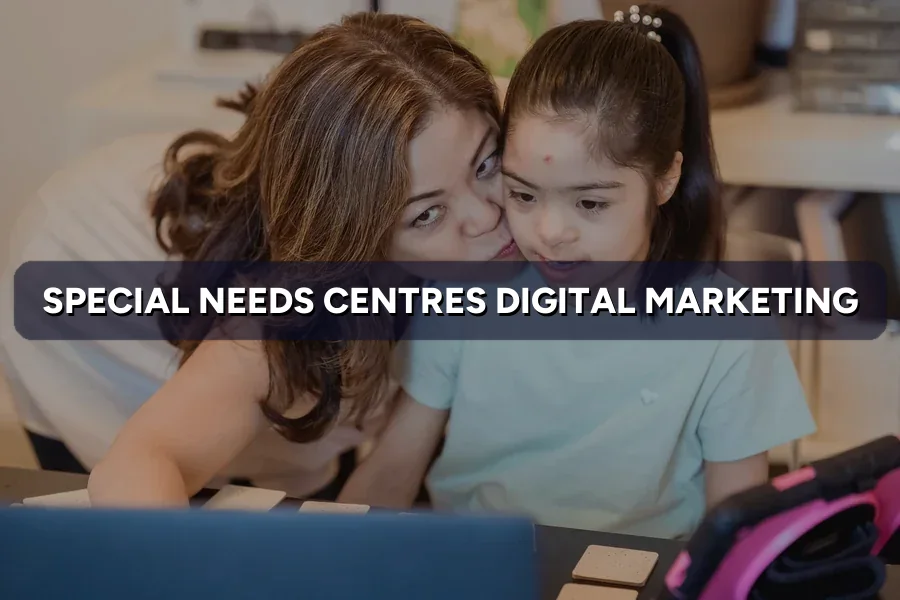
The message comes through at nine on a Tuesday night. A mother writes that her three-year-old was flagged at his check-up, that she does not really understand what was said to her, and asks whether you can see him. She is not comparing prices. She is trying to find out whether anybody can help.
Almost all the marketing advice written for therapy centres comes from markets where insurance pays and referral networks are formal. Neither describes Malaysia, where most families pay out of pocket, where registration sits under a 1993 care centres law, and where the wait for a public assessment pushes parents into the private sector long before they have worked out what they are buying.
If you run an early intervention, therapy or day care centre for children with additional needs, this guide applies the IZI Blueprint — the four-phase method we use in consulting engagements — to digital marketing for special needs centres specifically. It starts where the parent starts: with fear, and with whether you can be trusted.
How therapy practices fill slots without guesswork
Source video: Marketing for Therapists: How to Grow Your Practice Without Guesswork
PART 2 · THE MARKET
What the Malaysian Special Needs Market Looks Like in 2026
IN BRIEFLarge, undercounted and growing faster than the register suggests. More than 800,000 Malaysians are registered as OKU, learning disability is the biggest single category, and registration is voluntary — so the families you serve outnumber the official figures, much as they do across the sectors we advise.
Malaysia recorded 805,509 registered persons with disabilities in 2024, about 2.4 per cent of the population, according to the Department of Statistics’ Person With Disability Statistics, Malaysia, 2024. Learning disabilities alone account for 299,128 of them. Because registering for an OKU card is voluntary, that number is a floor and not a headcount.
- Demand is concentrated in early childhood. Students with special educational needs rose at every level in 2024, with primary enrolment in special education schools up 11.0 per cent in a single year, on the same DOSM release.
- Families are paying more of it themselves. Median monthly household gross income in households with a person with disabilities reached RM5,104 in 2024, up from RM4,390 in 2022, according to DOSM.
- The public queue creates your market. Waiting lists at government hospitals and community rehabilitation centres push parents towards private assessment far earlier than they had planned.
- Your real competitor is doing nothing. A large share of flagged children never reach any structured programme, because nobody explained what one costs or does.
PART 3 · DIAGNOSE
How Malaysian Parents Search for a Special Needs Centre
IN BRIEFA referral first, then a long private search to verify it. The shortlist does not form the way it does when parents pick a kindergarten, because the first search is not for a centre at all — it is for an explanation of what the doctor just said.
Five steps, and unlike most industries this one can take months.
- Somebody uses a word she does not know. A paediatrician, a nursery teacher or a grandparent says “delay” or “spectrum”, and the searching begins there — on the condition, not on you.
- She reads before she asks anyone. Weeks of quiet research, mostly on a phone, late at night, often without telling her own family yet.
- A name reaches her privately. A parent group, a support page, a therapist she was referred to. This is where most centres are actually discovered.
- She verifies the name online. Are they registered, who are the therapists, what does it cost, is it near enough to attend twice a week for a year.
- She asks one careful question. Usually about her own child, usually long, usually at night. How you answer that one message decides everything.
Plenty of enquiries, very few assessments booked?
That gap is almost never an advertising problem — it is usually what your page fails to say about qualifications and cost. Meet IZI Digital Marketing
PART 4 · DIAGNOSE
Where Special Needs Centres Lose Parents Before the Assessment
IN BRIEFSix leaks, and unnamed therapists is the costliest. The slow-reply problem is the same one that quietly drains enquiries from a GP clinic, except here the parent has waited months to write and will not chase you twice.
Open your own pages on a phone, late at night, and work down this list as if you were her.
- No therapists named or credentialled. She is handing over a child she cannot yet explain. “Our experienced team” tells her nothing she can verify.
- Registration invisible. Your JKM registration is what separates you from an unregistered room above a shop, and most centres never state it in text.
- No assessment price. The first purchase is an assessment, not a programme. If she cannot cost that single step, she postpones the whole thing.
- Only jargon, no plain language. A page written for professionals loses a mother who has just learnt the word “intervention”.
- A long reply, days late. Her message was written at midnight after weeks of hesitation. Silence reads as confirmation that nobody can help.
- No sense of what a session looks like. Without photographs of the actual rooms, she cannot picture her child there, and picturing it is the decision.
PART 5 · DESIGN
Which Channel Deserves Your First Ringgit?
IN BRIEFThe one that catches a parent already searching. For most centres that means local search and the map listing before anything paid, because therapy demands a weekly journey and distance rules out most of the country.
Four criteria settle it: how quickly the option produces a booked assessment, what it costs at its floor, how well it handles a subject most platforms restrict, and how much of your week it eats. That third criterion is the one generic marketing advice ignores, and it decides whether the money is even spendable.
DECISION BOX · FIRST CHANNEL FOR A SPECIAL NEEDS CENTRE
| Option | Speed to an assessment | Monthly floor | Handles a sensitive subject | Your time |
|---|---|---|---|---|
| Business Profile, service pages and reviews | 4–10 weeks | RM 0–500 | Very well — you control the wording | Low, but never stops |
| Search ads on therapy and assessment terms | Days | RM 1,500+ | Good — intent is already there | Low once set up |
| Meta ads to parents in the area | Days | RM 1,200+ | Awkward — health targeting is limited | Medium — needs careful copy |
| Paediatrician and parent-group referrals | 6 weeks–6 months | Time, not ringgit | Best of all — trust travels with it | High and personal |
Verdict: Publish the credentials and the assessment fee first — nothing paid converts without them. After that the choice depends on why your slots are empty. Choose search ads if parents in your area are already searching for assessments and choosing somebody else. Build referral relationships instead if you are new, unknown, or serving a town too small to generate search volume. Running paid ads and referral outreach at once, on a first budget, usually means doing neither properly.
Volume is the trap here. Clinical search terms in one township can be thin enough that a loosely targeted campaign spends most of its budget on curious readers rather than on parents who could actually attend twice a week.
PART 6 · DESIGN
Setting a Budget From One Child’s Full Programme Value
IN BRIEFBudget against the whole programme, not one session. A child in intervention for eighteen months is worth many times a single assessment — the same arithmetic that governs budgeting at a childcare centre, with higher fees and shorter enrolments.
Five numbers, in this order.
- Take your real average session fee. What families actually pay after package discounts, not the rate card figure.
- Multiply by sessions per month and months attended. Pull last year’s schedule. Most centres underestimate how long children stay.
- Deduct the cost of delivering it. Therapist hours, room, materials and admin. What remains is what winning one family is worth.
- Set an affordable cost per enrolment. Pick the share of first-year fees you will pay to acquire a family, then divide back through your assessment-to-enrolment rate.
- Cap the spend at your therapist hours. Advertising past capacity buys a waiting list, and waiting lists lose the parents who needed you soonest.
Want that ceiling worked out on your own schedule?
We run the programme-value calculation against your therapist hours and tell you what one enrolment can justify, rather than quoting a sector average that may not fit your fees. See how paid social handles a sensitive category
PART 7 · DESIGN
Website, Proof and the Registrations Parents Check
IN BRIEFOne booked assessment is the only outcome worth designing for, and your registrations are the strongest argument on the page. The credentialling logic is the same one that decides trust for a speech therapy practice, and it belongs in text, not in a photograph of a certificate.
Two registrations matter, and they are different things. A centre providing care, supervision, rehabilitation or training must register with the Social Welfare Department under the Care Centres Act 1993, and government guidance directs families to the JKM register of care centres and its official OKU care centre guidance. Separately, occupational therapists and speech-language therapists are regulated professions under the Allied Health Professions Act 2016, whose second schedule was amended to reflect current allied health practice. Say both in plain words. An unregistered competitor cannot.
- Every therapist named, with qualification and registration. Discipline, where they trained, how long they have practised.
- The assessment fee and what it includes. Duration, who conducts it, what report the parent receives afterwards.
- A session fee range per programme. Ranges are fine. Silence is not.
- Real photographs of the actual therapy rooms. Equipment and space, with children only where written consent exists.
- Plain-language explanations of each programme. Written for a parent who learnt the vocabulary three weeks ago.
PART 8 · DEPLOY
The First 90 Days, in Sequence
IN BRIEFTwo weeks diagnosing, two designing, then everything free before anything paid. The ordering principle is the one that also governs marketing an Islamic school: earn trust in public before you buy attention.
How to roll out digital marketing for special needs centres in 90 days
The order matters more than the speed. Six steps.
- Weeks 1–2: Diagnose. Run the six-point audit on a phone, then log where last year’s enrolments came from and which referral source produced each one.
- Weeks 3–4: Design. Pick the channel from the Decision Box, set the ceiling from your programme-value maths, and decide who answers evening enquiries and how fast.
- Weeks 5–6: Build the pages parents need. Named therapists, registrations, assessment fee, session ranges, and one clear way to book.
- Weeks 7–8: Photograph the real centre. Rooms, equipment and staff, with consent documented. Refresh the set each year.
- Weeks 9–10: Claim the Business Profile and build the referral list. List each therapy as its own service, then meet the paediatricians and parent groups who already send families.
- Weeks 11–12: Deploy one paid channel to its floor. Run it three full months without touching it weekly, then read the Part 10 numbers.
PART 9 · DEPLOY
Local Visibility: Google Business Profile and Parent Reviews
IN BRIEFThe map listing is the cheapest asset you own and the first thing a parent opens after somebody names you. Keep it in-house and treat local search as the verification layer beneath every referral.
There is no paid shortcut. Google’s guidance on improving local ranking confirms that buying ads does not lift a map position, so the listing rewards maintenance rather than budget — which suits a centre with more clinical hours than cash.
- List each therapy as a separate service. Occupational therapy, speech therapy, early intervention and assessment match real searches; “special needs centre” alone matches very few.
- Post plain-language explainers, not offers. A short post on what an assessment involves does more than any discount ever will.
- Ask for reviews at a progress milestone. A parent who has just watched her child do something new writes something specific and warm.
- Never discuss a child in a review reply. Thank, acknowledge, and move the detail to a private channel. Everything else is a confidentiality risk.
- Keep hours and therapist availability accurate. Families plan work leave around your schedule, sometimes weeks ahead.
BENCHMARK BRIEFING 1 OF 4
Which Disabilities Are Actually Registered in Malaysia?
IN BRIEFLearning disability leads, and speech is almost invisible on the register. That gap between registered speech disability and actual demand for speech therapy tells you which services to name explicitly in your local listings.
| Disability category | Registered persons | Share of register | Reading for a centre |
|---|---|---|---|
| Learning disabilities | 299,128 | 37.1% | Your core market; name the sub-needs, not the label |
| Physical disabilities | 286,634 | 35.6% | Physiotherapy and access language matter here |
| Remaining categories, derived | 146,946 | 18.2% | Hearing, mental and multiple disability registrations |
| Visual impairment | 68,665 | 8.5% | Specialist demand; referral beats advertising |
| Speech disabilities | 4,136 | 0.5% | Badly under-registered against real therapy demand |
| All registered persons | 805,509 | 100% | 2.4% of the population, and registration is voluntary |
Aggregated by IZI Digital Marketing from the Department of Statistics Malaysia’s Person With Disability Statistics, Malaysia, 2024; the remaining-categories row is derived as the residual of the published total. Licence.
The speech row is the one worth rereading. Four thousand registrations nationwide, against a therapy discipline that fills private waiting lists — proof that the register counts cards issued, not children who need help.
BENCHMARK BRIEFING 2 OF 4
What Can a Malaysian OKU Family Actually Afford?
IN BRIEFMore than in 2022, but the cash support is small and narrowly targeted. Household income is rising while state assistance stays modest, which shapes how you price and phrase everything — a pattern worth understanding before you plan growth in any care sector.
| Measure | 2022 | 2024 | What it means for pricing |
|---|---|---|---|
| WHO RECEIVES JKM CASH ASSISTANCE, 2024 | |||
| Assistance for PWD unable to work | — | 120,844 | Largest group, 46.0% of all recipients |
| PWD worker allowance | — | 106,055 | 40.4%; supports employment, not therapy |
| Care of bedridden or chronically ill PWD | — | 34,476 | 13.1%; carer-directed rather than child-directed |
| All assistance recipients | — | 262,618 | RM1.1 billion total; roughly a third of the register |
| WHAT PWD HOUSEHOLDS EARN EACH MONTH | |||
| Median gross household income | RM4,390 | RM5,104 | Weekly therapy is a serious share of this |
| Mean gross household income | RM5,679 | RM6,540 | A minority of families can fund intensive programmes |
| Mean monthly consumption expenditure | RM3,974 | RM4,545 | Little headroom; payment plans win enrolments |
Aggregated by IZI Digital Marketing from the Department of Statistics Malaysia’s Person With Disability Statistics, Malaysia, 2024. Dashes mark figures not published for that year. Licence.
Read the last two rows together. Mean income of RM6,540 against RM4,545 of spending leaves perhaps RM2,000 a month, and therapy competes with everything else in that gap. This is why a published payment plan converts better than a discount.
Not sure your fees match your catchment?
Income figures are a starting point, not an answer — the decision turns on who actually lives within a twice-weekly drive of your centre. See how local demand is tested before you commit
BENCHMARK BRIEFING 3 OF 4
What Does Each Monthly Budget Buy a Special Needs Centre?
IN BRIEFSmall enquiry counts that repay within weeks, because one enrolment runs for months. The entry tier spends almost nothing on advertising and almost everything on the listing, the pages and reviews.
| Monthly budget and mix | Projected enquiries | Enquiries | Cost each | Assessments | Enrolments | Payback |
|---|---|---|---|---|---|---|
| RM 500 — profile, service pages, reviews | 7 | RM 71 | 3 | 2 | 0.2 mth | |
| RM 1,500 — plus Meta ads within 10km | 18 | RM 83 | 8 | 4 | 0.3 mth | |
| RM 3,000 — plus search ads on assessment terms | 31 | RM 97 | 14 | 7 | 0.4 mth | |
| RM 6,000 — plus parent education content | 52 | RM 115 | 23 | 12 | 0.4 mth |
Illustrative model by IZI Digital Marketing, assuming RM1,200 of monthly programme fees per child, a 45 per cent enquiry-to-assessment rate and a 50 per cent assessment-to-enrolment rate. Not measured results. Licence.
Notice how little the cost per enquiry matters. Even the top tier repays inside a month, so the only real question is whether you have the registered therapist hours to take twelve more children.
BENCHMARK BRIEFING 4 OF 4
Is Autism Among Malaysian Schoolchildren Still Rising?
IN BRIEFSharply, and the identified rate rose by almost half in four years. Rising identification means younger referrals arriving earlier, which changes the age you plan services around — the same planning question faced when sizing a kindergarten intake.
| Year | Per 1,000 children | Roughly one in | Reading for a centre |
|---|---|---|---|
| 2018 | 6.34 | 158 | The baseline most older planning assumptions use |
| 2022 | 9.29 | 108 | Latest published figure; primary age highest |
| Change, 2018 to 2022 | +2.95 | +46.5% | Identification is improving faster than capacity |
| 2026, modelled projection | 12.24 | 82 | Projection, not measured results |
Published figures from the Malaysian Journal of Public Health Medicine study of autism prevalence among school-age children, using Ministry of Education school data. The 2026 row is a modelled projection by IZI Digital Marketing extending the average annual change. Licence.
Whether the underlying rate is truly rising or simply being identified better matters less than the operational consequence: more families arrive each year, earlier, and with a diagnosis they did not expect.
PART 10 · DRIVE
The Numbers That Tell You It’s Working
IN BRIEFFive numbers, read monthly, and therapist utilisation outranks all of them. Enquiry counts flatter a centre that is quietly losing families after eight weeks, which is why visibility work is judged on retention, not on traffic.
Review these on the same day each month, with last month beside them.
- Cost per enquiry, by channel. Total spend divided by genuine parent enquiries. Exclude supplier messages and job applications.
- Enquiry-to-assessment rate. The single most diagnostic number you have. Below a third, the problem is your reply, not your advertising.
- First reply time, measured in hours. Track it for evenings and weekends separately, because that is when these messages arrive.
- Therapist utilisation. Booked hours against available hours. This is the real ceiling on everything above.
- Retention past three months. Families who stop early rarely complain. They simply disappear, and they were your best referral source.
Agree in advance what would make you stop. A channel that has run three full months without producing a single assessment has answered the question, and moving the budget is a decision, not a failure.
FAQ
Common Questions About Digital Marketing for Special Needs Centres
1. How much should a Malaysian special needs centre spend on marketing each month?
Between RM500 and RM3,000 a month suits most single-branch centres. The right figure depends on your free therapist hours rather than your revenue, because enquiries you cannot schedule become a waiting list that quietly damages your reputation. Count the empty slots before you set any budget.
2. Does a special needs centre need to register with JKM before it advertises?
Yes, if you provide care, and the certificate is your strongest advertisement. It depends on what you actually run, since residential and day care centres fall under the Care Centres Act 1993 while a clinic-style therapy practice is regulated mainly through its individual practitioners instead.
3. How do Malaysian parents actually find a special needs centre?
A paediatrician or a parent support group names you first, then they search to verify you. How much that search matters depends on how well referred you already are, though even a strongly recommended centre gets checked online before anyone books. Both routes end at your listing.
4. Should a special needs centre publish its therapy fees online?
Publish the assessment fee and a session range. How precise you can be depends on how many programme types you run, but hiding the figure loses the parent pricing three centres in one evening, and she is usually the one most ready to start.
5. Is Google or Facebook better for filling therapy slots?
Google first, because a parent searching has already been told something is wrong. It depends on your catchment, though: in a smaller town where few people search clinical terms, Meta ads and parent groups reach families earlier in the journey.
THE VERDICT
Your Decision Checklist
You should now be able to make four decisions about digital marketing for special needs centres.
- Which families you are actually equipped to serve. Named by need and age band, published in plain language, and matched to the therapists you employ.
- What your pages must produce. One booked assessment, from a page carrying registrations, credentials, a fee and a reply within hours.
- Where your first ringgit goes. Search when parents are already looking; referral relationships when they are not yet looking for you.
- What would make you change course. Agreed before you spend, and read against therapist utilisation rather than enquiry volume.
One honest caveat: if your therapists are fully booked and families are already waiting weeks for an assessment, marketing is not your constraint and nobody should be selling you any. Recruit, extend your hours, and revisit this once there is room.
Not sure whether your empty slots are a marketing problem at all?
Book a free Blueprint consultation. We map where your enquiries come from, work out what one enrolment can justify spending, and leave you with a sequenced plan — yours to run with us or without us.