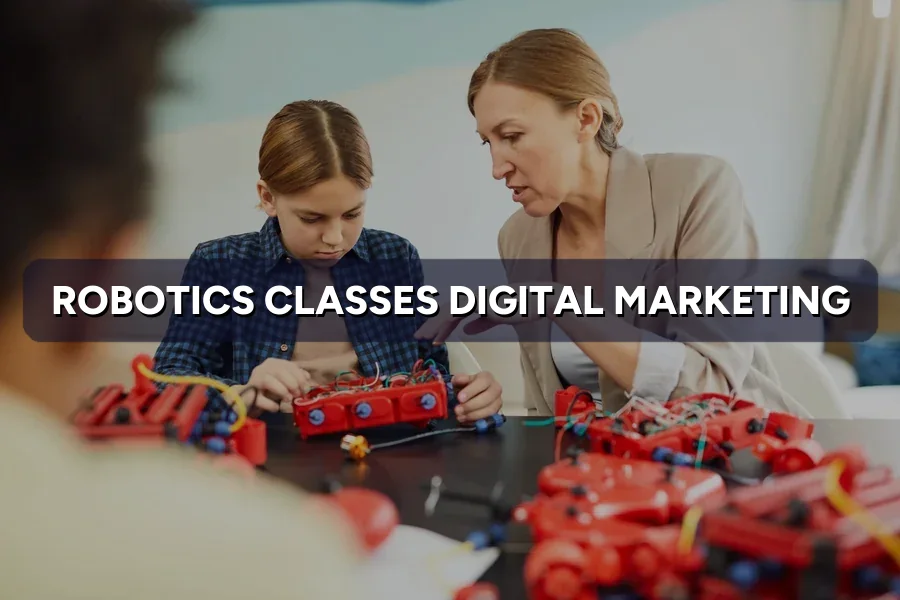
A mother watches a thirty-second clip of a child driving a line-following robot. Her son is nine. She saves the video, says nothing for a fortnight, then opens your page at midnight with one question: is this a syllabus, or is it a toy shop with a timetable?
Most advice written for STEM businesses comes from markets where after-school enrichment is a mature category with settled prices. Malaysia is not that market. Here a robotics centre is often explaining what it even is, to a parent comparing it against tuition she already understands.
If you run a robotics class, a STEM studio or a coding-and-robotics centre anywhere in Malaysia, this guide applies the IZI Blueprint — the four-phase method we use in consulting engagements — to digital marketing for robotics classes. It starts with the question that actually blocks the sale.
Why parents decide about a school in under thirty seconds
Source video: Struggling With School Enrollment? Try These 4 Marketing Strategies
PART 2 · THE MARKET
What Malaysia’s Robotics-Class Market Looks Like in 2026
IN BRIEFSmall, young and pulled along by national policy. STEM take-up is climbing fast enough that parents now treat it as a school subject rather than a hobby — which changes what they expect to read before paying, across every sector we advise.
Upper-secondary STEM enrolment reached 50.83 per cent in 2024, up from 41.84 per cent in 2019, according to Bernama. The same report put Malaysia Techlympics participation at 1.7 million in 2025. Neither figure counts your paying students, but both tell you the mood parents arrive in.
- Robotics has become respectable. Five years ago it argued for its own existence. Now it argues about which centre teaches it properly.
- Your competitor is tuition, not another studio. Most parents are choosing between robotics and an extra maths class, on one budget line.
- Catchment is brutally small. A weekend class means a weekly drive, so realistically you sell inside a fifteen-minute radius.
- Nobody knows what a fair price is. With no settled market rate, a published fee is reassuring rather than risky.
PART 3 · DIAGNOSE
How Malaysian Parents Decide to Enrol a Child in Robotics
IN BRIEFSlowly, and rarely on a search. The trigger is usually a video or a friend’s child, not a need — which makes this a longer decision than choosing a kindergarten, where a deadline forces the issue.
Four steps, and the whole thing can take a term.
- Something sparks it. A classmate’s robot, a school competition, a reel. The child asks; the parent files it away.
- She researches quietly. What robotics actually teaches, at what age, and whether it leads anywhere academically.
- She shortlists two centres. Usually the two she can drive to. Curriculum and tutors decide it far more often than price.
- The child sits a trial. One session, and the parent watches. This is where the sale is won, not on your website.
Getting enquiries but almost no trial bookings?
That gap is a proof problem, not a traffic problem — parents are stalling because nothing on your pages tells them the teaching is structured. Meet IZI Digital Marketing
PART 4 · DIAGNOSE
Where Robotics Centres Lose Parents Before the Trial Class
IN BRIEFSix leaks, and the missing syllabus is the expensive one. The slow-reply leak is the same one that drains enquiries from a coding school, except a robotics parent is already half-suspicious that she is buying toys.
Open your own pages on a phone and read them as a sceptical parent would.
- No syllabus, only adjectives. “Fun, hands-on, future-ready” describes a birthday party. Levels, hours and outcomes describe a course.
- Ages not stated per level. A parent with a seven-year-old cannot tell whether anything here is for him.
- Tutors anonymous. Without names and backgrounds, the class could be run by anybody.
- No fees at all. She is comparing you against a RM200 tuition slot. Silence makes you sound expensive, not exclusive.
- Only finished-robot photos. Parents want to see children debugging and fixing. That is the product.
- A reply on Monday. These messages land on Saturday afternoons, from a parent who has finally decided to act.
PART 5 · DESIGN
Which Channel Deserves Your First Ringgit?
IN BRIEFUsually the one that creates demand rather than catches it. Robotics has thin search volume in most districts, so local search works as the verification layer while something else does the introducing.
Four criteria settle it: how fast a trial gets booked, the monthly floor, whether the channel can carry a decision parents make on instinct, and how much of your week it consumes.
DECISION BOX · FIRST CHANNEL FOR A ROBOTICS CLASS
| Option | Speed to a trial booking | Monthly floor | Creates or catches demand | Your time |
|---|---|---|---|---|
| Business Profile, course pages and parent reviews | 4–10 weeks | RM 0–400 | Catches — and verifies everything else | Low, but never stops |
| Search ads on robotics and coding class terms | Days | RM 1,000+ | Catches — if your district searches at all | Low once set up |
| Short build videos to parents within 10km | 1–3 weeks | RM 800+ | Creates — best fit for this category | Medium — needs weekly footage |
| Holiday workshops and school partnerships | One school term | Time, not ringgit | Creates — parents watch the teaching | High and hands-on |
Verdict: Publish the syllabus, tutors and fee range first — no channel converts without them. Then run build videos to your ten-kilometre radius if parents in your area have never heard of robotics classes, or search ads if they are already comparing centres and choosing somebody else. Funding both on a first budget funds neither properly.
Volume is the trap here. In a smaller town, a loose campaign on the word “robotics” spends most of its budget on hobbyists and engineering students three states away.
PART 6 · DESIGN
Setting a Budget From One Child’s Full Enrolment Journey
IN BRIEFBudget against the whole progression, not one term’s fee. A child who climbs three levels is worth several times a single sign-up — the same arithmetic that governs enrolment budgeting at a school, compressed into a shorter run.
Five numbers, in this order.
- Take your real average monthly fee. After sibling discounts and package deals, not the rate on the poster.
- Multiply by months actually attended. Pull last year’s leavers. Most centres guess high, then find the median child stays under a year.
- Deduct the cost of teaching that child. Tutor hours, kit wear, consumables, rent per seat. What remains is what one family is worth.
- Set an affordable cost per enrolment. Choose the share of that margin you will spend, then divide by your trial-to-enrolment rate.
- Cap spending at your empty seats. A class of twelve with three spaces cannot absorb thirty enquiries, and a waiting list sends families elsewhere.
Want that ceiling worked out on your own retention figures?
We run the progression calculation against your real length of stay rather than a category average that may flatter you. See how paid social reaches parents in one neighbourhood
PART 7 · DESIGN
Website, Proof and the Registration Parents Check
IN BRIEFOne booked trial is the only outcome worth designing for, and your registration is the argument nobody else on your street is making. The credentialling logic mirrors what reassures parents at an early intervention centre.
Enrichment and tuition centres are private education institutions under the Education Act 1996, and the Ministry of Education requires them to register, with tuition-centre applications handled by the state education department under the Ministry’s private education registration rules. Most centres file that certificate and forget it. It is the fastest way to separate yourself from a hobbyist running classes out of a shoplot.
- Registration stated in text. Named authority, in words a parent and a search engine can both read. Not a photograph of a certificate.
- A syllabus per level, with ages and hours. What the child can build by the end of it. This is the page that converts.
- Named tutors with backgrounds. Engineering degree, competition record, years teaching. Two sentences each is enough.
- A monthly fee range and what it covers. Kit, materials, competition entry, make-up classes. Ranges are fine; silence is not.
- Student work, not marketing shots. Short clips of real builds failing and then working, with consent on file.
PART 8 · DEPLOY
The First 90 Days, in Sequence
IN BRIEFTwo weeks diagnosing, two designing, then everything free before anything paid. It is the same ordering principle that governs a clinic’s first ninety days: make the proof readable before you buy attention.
How to roll out digital marketing for robotics classes in 90 days
The order matters more than the pace. Six steps.
- Weeks 1–2: Diagnose. Run the six-point audit on a phone, then log where this year’s enrolments came from and who referred each one.
- Weeks 3–4: Design. Pick the channel from the Decision Box, set the ceiling from your progression maths, and decide who answers weekend messages.
- Weeks 5–6: Publish the pages parents check. Registration, syllabus per level, named tutors, fee range, and one way to book a trial.
- Weeks 7–8: Film a normal class. Children building, debugging, testing. Thirty seconds each, shot on a phone.
- Weeks 9–10: Claim the Business Profile and work the schools. List each level separately, then offer a holiday workshop to two nearby primary schools.
- Weeks 11–12: Deploy one paid channel to its floor. Run it three full months without weekly fiddling, then read the Part 10 numbers.
PART 9 · DEPLOY
Local Visibility: Google Business Profile and Parent Reviews
IN BRIEFThe cheapest asset you own, and the first thing a parent opens after a friend names you. Keep it in-house and treat the map listing as the place every referral gets checked.
There is no paid shortcut. Google’s guidance on improving local ranking confirms that advertising does not lift a map position, so the listing rewards upkeep rather than budget.
- List each programme as its own service. Junior robotics, Arduino, competition team, holiday workshop. “Robotics class” alone matches almost nothing.
- Post the ordinary Saturday. A half-built robot on a bench beats a graphic announcing a discount.
- Ask for reviews at the end of a level. A parent who just watched a showcase writes something specific and warm.
- Never name a child in a reply. Thank, acknowledge, take the detail private. Anything else is a safeguarding risk.
- Keep class times and the term calendar accurate. Parents plan weekends around your timetable, often a month ahead.
BENCHMARK BRIEFING 1 OF 4
How Many Malaysian Students Are Actually in STEM?
IN BRIEFJust over half, and the number has moved nine points in five years. That is the fastest-shifting backdrop any Malaysian enrichment category has, and it explains why education businesses we advise now find parents pre-sold on the subject itself.
| Measure | Figure | Reading for a robotics centre |
|---|---|---|
| STEM enrolment, upper secondary, 2019 | 41.84% | The market you opened into, if you started early |
| STEM enrolment, upper secondary, 2023 | 45.73% | Recovery under way, but still a minority subject |
| STEM enrolment, upper secondary, 2024 | 50.83% | Past halfway — STEM is now the default, not the exception |
| National 60:40 policy target | 60% | Unmet since 1970, so the policy push continues |
| Gap to target, 2024, derived | 9.17 points | Public funding and school programmes keep flowing |
| Five-year change, 2019 to 2024, derived | +8.99 points | Parent attitudes have shifted faster than your pricing |
| Proposed pure-science enrolment by 2035 | 20% | A decade of tailwind for anyone teaching the basics well |
Aggregated by IZI Digital Marketing from STEM enrolment and policy figures reported by Bernama, 13 May 2026. The two derived rows are calculated from the published percentages. Licence.
The derived rows are the useful ones. Nine points of movement in five years means the parent objection has quietly changed from “why robotics” to “why yours”.
BENCHMARK BRIEFING 2 OF 4
Why Do Malaysian Parents Pay for Extra STEM Help?
IN BRIEFBecause their children find these subjects hard, and the international scores say so plainly. Anxiety, not ambition, is the dominant buying motive — a distinction worth carrying into every ad you write.
| Measure | PISA 2022 | What it means for your message |
|---|---|---|
| PERFORMANCE AGAINST THE OECD | ||
| Malaysia’s scientific literacy score | 416 | Bottom third internationally |
| OECD average | 485 | A 69-point gap parents read about in the news |
| MOVEMENT SINCE 2018 | ||
| Mathematics score change | −32 points | The sharpest fall; name it in your copy |
| Science score change | −21 points | Reinforces the same parental worry |
| HOW STUDENTS FEEL ABOUT THE SUBJECTS | ||
| Disagreed that Mathematics is easy | 65% | Two in three children arrive already discouraged |
| Disagreed that Science is easy | 49% | Half the room needs confidence before content |
Aggregated by IZI Digital Marketing from PISA 2022 results for Malaysia as reported by Bernama, 13 May 2026. Licence.
Read the bottom block twice. Most robotics marketing sells excitement, but the parent paying for it is often trying to rescue a child who has decided he is bad at maths.
Writing ads that sound like everyone else’s?
The winning message in this category is usually confidence rather than excitement, and that is a testable choice, not a matter of taste. Compare how coding schools position the same worry
BENCHMARK BRIEFING 3 OF 4
What Does Each Monthly Budget Buy a Robotics Centre?
IN BRIEFModest enquiry counts that repay in about a month, because a child stays for several levels. The entry tier spends almost nothing on advertising and almost everything on listing and review discipline.
| Monthly budget and mix | Projected enquiries | Enquiries | Cost each | Trials | Enrolments | Payback |
|---|---|---|---|---|---|---|
| RM 500 — profile, course pages, reviews | 11 | RM 45 | 6 | 2 | 0.9 mth | |
| RM 1,500 — plus build videos within 10km | 28 | RM 54 | 14 | 6 | 0.9 mth | |
| RM 3,000 — plus search ads on class terms | 50 | RM 60 | 25 | 10 | 1.1 mth | |
| RM 6,000 — plus holiday-workshop campaign | 84 | RM 71 | 42 | 17 | 1.3 mth |
Illustrative model by IZI Digital Marketing, assuming RM280 in average monthly fees per child, roughly half of enquiries becoming a trial class and roughly two in five trials becoming an enrolment. Not measured results. Licence.
Notice how little the cost per enquiry matters. Every tier repays within roughly a month, so the binding question is whether you have seventeen empty seats and the tutors to teach them.
BENCHMARK BRIEFING 4 OF 4
Is Demand for STEM Learning in Malaysia Still Growing?
IN BRIEFYes, on both the school measure and the participation measure. The gap to the national target has more than halved since 2019, which is a rare tailwind among the industries we work with.
| Demand signal | 2019 | 2023 | 2024 | 2025 | 2027, modelled |
|---|---|---|---|---|---|
| Upper-secondary STEM enrolment | 41.84% | 45.73% | 50.83% | Not published | About 55% |
| Gap to the 60% target, derived | 18.16 pts | 14.27 pts | 9.17 pts | Not published | About 5 pts |
| Malaysia Techlympics participants | Not published | About 1.4m | About 1.4m | 1.7m | Above 1.7m |
Published figures reported by Bernama, 13 May 2026; the annual Techlympics figure is the reported average. The 2027 column is a modelled direction by IZI Digital Marketing extending the published trend — not measured results. Licence.
The middle row is the one to sit with. A shrinking gap means the policy money keeps coming, and school-run competitions will keep handing you warm enquiries you never paid for.
PART 10 · DRIVE
The Numbers That Tell You It’s Working
IN BRIEFFive numbers, read monthly, and level progression outranks all of them. Enquiry counts flatter a centre quietly losing every child after one term, which is why visibility work is judged on seats held, not on traffic.
Review these on the same day each month, with last month beside them.
- Cost per enquiry, by channel. Spend divided by genuine parent enquiries. Exclude supplier messages and job applications.
- Enquiry-to-trial rate. Your most diagnostic figure. Below a third, the problem is what your pages fail to prove.
- Trial-to-enrolment rate. This one grades the class itself, not the marketing. Treat a fall here as a teaching issue.
- First reply time, in hours. Track weekends separately, because that is when these messages arrive.
- Level-two progression rate. The share of children who continue past the first level. It is the whole business model in one number.
Agree in advance what would make you stop. A channel that has run three full months without a single trial booking has already answered the question.
FAQ
Common Questions About Digital Marketing for Robotics Classes
1. How much should a Malaysian robotics class spend on marketing each month?
Between RM500 and RM3,000 a month suits most single-branch centres. The right figure depends on your empty seats rather than your revenue, because enquiries you cannot teach become a waiting list that sends families to the centre down the road. Count the vacancies first.
2. Does a robotics class need to register with the Ministry of Education?
Yes, and the registration is one of your strongest selling points. It depends on how you operate, since enrichment and tuition centres register as private education institutions under the Education Act 1996 while a purely occasional workshop may sit differently. Confirm your position with the state education department.
3. How do Malaysian parents find a robotics class for their child?
Through a friend, a school competition or a video, then a search to verify you. How much the search matters depends on how well known you already are locally, though even a recommended centre gets checked online before any parent books a trial.
4. Should a robotics centre publish its fees online?
Publish a monthly range and state what it includes. How precise you can be depends on how many levels and kit options you run, but hiding the figure loses the parent pricing three activities in one evening, and she is usually the one closest to deciding.
5. Is Google or Facebook better for filling robotics class seats?
Facebook and Instagram usually, because most parents are not searching for this yet. It depends on your district, though: where families already compare centres by name, search ads reach a parent who has finished deciding that robotics is worth paying for.
THE VERDICT
Your Decision Checklist
You should now be able to make four decisions.
- Which families you are built to serve. Named by age band, level and driving distance, and matched to the tutors you actually employ.
- What your pages must produce. One booked trial, from a page carrying your registration, a syllabus per level, named tutors and a fee range.
- Where your first ringgit goes. Build videos when your area has never heard of robotics classes; search ads when parents are already comparing.
- What would make you change course. Agreed before you spend, and read against seats held rather than enquiry volume.
One honest caveat: if every class is full and you are turning children away, marketing is not your constraint. Hire and train a second tutor first, then come back to this.
Not sure whether your empty seats are a marketing problem at all?
Book a free Blueprint consultation. We map where your enrolments come from, work out what one child’s progression can justify spending, and leave you with a sequenced plan — yours to run with us or without us.