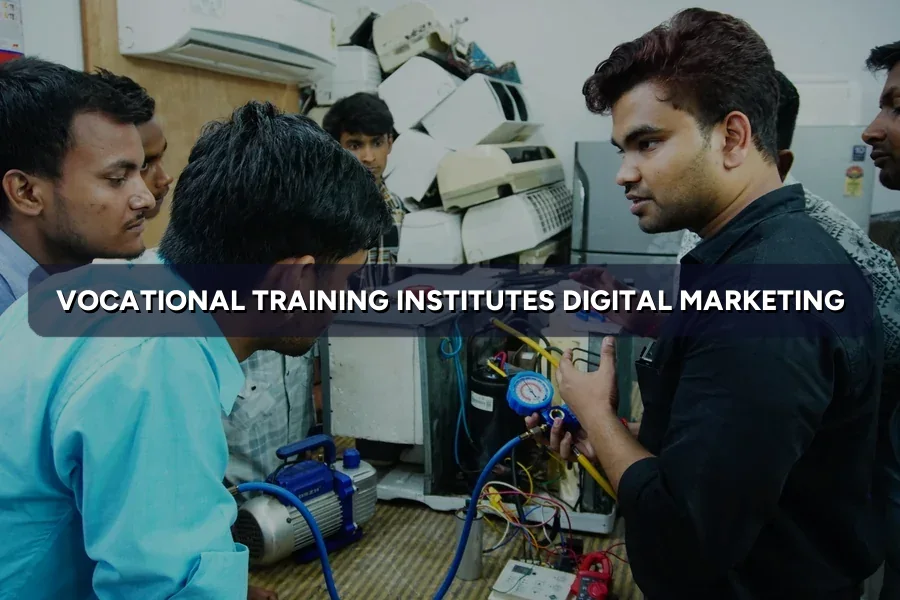
Vocational training in Malaysia has a demand problem and a perception problem, and only one of them is yours to fix. Under the previous education blueprint, TVET enrolment climbed from 4.6 per cent in 2013 to 11.14 per cent in 2024. The new National Education Blueprint pushes for 20 per cent, as Bernama reported when the plan was launched in January 2026.
So the pipeline is widening. What has not changed is that most families still treat skills training as the fallback, and most institute websites answer that doubt with a photograph of a workshop and a phone number.
If you run a private skills centre, a vocational college or a JPK accredited centre anywhere in Malaysia, this guide applies the IZI Blueprint, the four-phase method we use in consulting engagements, to digital marketing for vocational training institutes specifically.
The marketing mistakes skills schools keep repeating
Source video: Top 5 Marketing Mistakes Trade Schools Make (and how to fix them)
PART 2 · THE MARKET
What the Malaysian Vocational Training Market Actually Looks Like
IN BRIEFA growing, policy-backed market where the product is standardised and the buyer is sceptical. That combination rewards proof over persuasion, and it makes search advertising unusually efficient, because the people searching have already decided skills training is acceptable.
Four features set this industry apart from every other education business.
- The certificate is national, not yours. The Malaysian Skills Certificate is awarded against national occupational standards, so the qualification is identical wherever it is earned.
- The buyer is often not the student. For school leavers a parent signs and pays, and the parent is the one who needs convincing.
- Policy is pushing demand toward you. Enrolment targets, funding schemes and employer levies all widen the pipeline without you spending a ringgit.
- Almost nobody competes on outcomes. Course lists are everywhere; published employment outcomes are rare, which leaves the strongest argument unclaimed.
The first two are constraints you cannot change. The last two are the opening, and they are why a small centre with honest outcome data can outrank a much larger one.
PART 3 · DIAGNOSE
How Malaysians Choose a Vocational Institute
IN BRIEFA results slip or a job knock-back starts it, a course search shortlists two or three, and the funding answer settles it. The journey runs far longer than the one behind driving school enquiries, because a family is committing a year, not a fortnight.
Follow the sequence before funding any part of it.
- A door closes. SPM results arrive, a university offer does not, or a factory job stalls for want of a certificate.
- Someone searches the trade, not the school. “Kursus welding”, “automotive course after SPM”, “sijil kemahiran Malaysia kolej”.
- The parent checks whether it is recognised. Accreditation, certificate level and whether employers accept it. This is the make-or-break step.
- They hunt for the total cost and the funding route. Fees, hostel, tools, and which loan or sponsorship covers it.
- They look for evidence of jobs. Graduate names, employers, starting pay. Usually they find nothing and assume the worst.
- They message or walk in, then wait for the intake date. The institute that answered the recognition question first is the one they visit.
Notice that three of the six steps are about doubt, not desire. Marketing that only advertises courses is arguing at the wrong step.
Enquiries every week, half-empty intakes anyway?
A Blueprint diagnosis walks every enquiry from first search to registration day and names the doubt that quietly ends most of them. Meet IZI Digital Marketing
PART 4 · DIAGNOSE
Where Vocational Institutes Lose Enquiries Before Registration Day
IN BRIEFSix leaks account for most of the intake that never reaches you, and five cost nothing but an afternoon of writing. Fixing the free ones before buying traffic is the same order of work we apply across every industry we serve.
Run this audit on your own phone, as a parent with RM10,000 and no idea how skills certification works.
- Accreditation buried or absent. A photographed certificate in the gallery is invisible to search and unreadable to a worried parent.
- No total cost, no funding route. Fees split across three pages, with no mention of who lends or sponsors, reads as something to be hidden.
- No intake dates. A family deciding in March needs to know whether the next cohort starts in June or next January.
- One page listing every course. Welding, automotive and culinary are three different searches from three different households.
- Zero graduate outcomes. No employers named, no starting salaries, no alumni. The one argument that answers the “second choice” doubt is missing.
- Messages answered next working day. Enquiries arrive at night from parents after their shift, and go to whoever replied that evening.
PART 5 · DESIGN
Which Channel Deserves Your First Ringgit?
IN BRIEFCourse searches carry real intent, but intakes are seasonal, which changes the usual answer. The trade-off examined in local SEO against Google Ads tilts toward paid search in the eight weeks around results season and back toward organic the rest of the year.
Judge each option on four things: how fast it produces a registration, the monthly floor it needs to work at all, which buyer it reaches, and how much of your own week it eats.
DECISION BOX · FIRST CHANNEL FOR A SKILLS INSTITUTE
| Option | Speed to a registration | Monthly floor | Who it reaches | Your time |
|---|---|---|---|---|
| Course and outcome pages | 8–16 weeks | One-off build | Everyone comparing, all year | High, then none |
| Business Profile and graduate reviews | 3–6 weeks | RM 0–500 | Families searching nearby | Low, but weekly |
| Search ads on trade and course terms | Days | RM 2,500+ | People already shortlisting | Low once set up |
| Meta ads to parents in the state | 1–2 weeks | RM 1,800+ | Families not yet looking | Medium, needs video |
Verdict: Build the course and outcome pages first, because they answer the recognition and jobs doubts once and keep answering them for years. Add search ads in the weeks around SPM and STPM results, when the whole cohort decides at once; add Meta only when you have workshop and graduate video worth watching.
Skills training marketing rarely fails on channel choice. It fails when a well-aimed advert lands on a page that never says the certificate is recognised.
PART 6 · DESIGN
Setting a Budget From What One Student Is Worth
IN BRIEFA full programme fee spread over twelve to twenty-four months, minus the students who drop out. That is closer to the enrolment maths behind private college marketing than to any local service business, and it must be costed per seat.
Work through five numbers instead of copying last year’s figure.
- Take the full programme fee. Everything you actually collect per student, including tools, uniform and assessment charges.
- Deduct completion risk. If one in six withdraws before the final module, your real revenue per registration is lower than the brochure says.
- Deduct delivery cost per seat. Trainer hours, consumables and workshop time. Skills training carries a far heavier variable cost than classroom teaching.
- Set the affordable cost per enrolment. Decide the share of that margin you will pay, then work back through your enquiry-to-registration rate.
- Cap spend at workshop capacity. Forty registrations against twenty-four bench spaces produces refunds and complaints, not growth.
Want a second opinion on your cost-per-enrolment ceiling?
Bring last year’s registrations, your completion rate and your bench capacity, and we rebuild the ceiling from your own numbers. See the same maths run for corporate training providers
PART 7 · DESIGN
Website, Offer and the JPK Trust Signals Parents Check
IN BRIEFYour site has one job: turn a doubtful parent into a registration at a named intake. Accreditation, total cost and graduate outcomes exist to remove doubt, and all three need to be crawlable text if your search visibility is to do any work.
Accreditation is the trust signal almost every institute hides in a photograph. The Department of Skills Development approves accredited centres to deliver training and award the Malaysian Skills Certificate against national occupational standards. So state your centre code, your accredited programmes and the certificate level each one awards, in readable text near the top of the page.
Five things belong on the site as text a search engine can read.
- Accreditation, written out. Centre code, accredited programmes, and the SKM level each one awards. Plain text, near the top.
- Total programme cost and funding route. Fees added up, with the loan or sponsorship route named rather than hinted at.
- One page per trade. Written for whoever searches that trade, with the actual syllabus modules listed.
- Graduate outcomes with names and employers. Even ten verified placements beat a page of adjectives.
- Intake dates for the next twelve months. A published calendar converts “maybe later” into a decision with a deadline.
PART 8 · DEPLOY
The First 90 Days, in Sequence
IN BRIEFTwo weeks diagnosing, two designing, then the free foundations built properly before any paid reach. When the paid channel comes, the comparison in Google Ads against Meta Ads should be read against your intake calendar, not against general advice.
How to roll out digital marketing for vocational training institutes in 90 days
Six steps, in order.
- Weeks 1–2: Diagnose. Run the Part 4 audit on a phone, then count last year’s enquiries, registrations and completions by source and by trade.
- Weeks 3–4: Design. Pick the first channel from the Decision Box and set the spending ceiling from the margin on one completed seat.
- Weeks 5–7: Publish the trade and accreditation pages. One page per trade, each stating the certificate level, the total cost and the next intake date.
- Weeks 8–9: Build the outcomes page. Interview ten recent graduates, name their employers with permission, and publish starting roles.
- Weeks 10–11: Claim and fill the Business Profile. Correct hours, each trade listed as a service, real photographs of the workshop and current cohorts.
- Weeks 12–13: Deploy one paid channel and read it. Fund it to its floor ahead of an intake, then use the Part 10 numbers to scale, hold or stop.
PART 9 · DEPLOY
Local Visibility: Google Business Profile and Graduate Reviews
IN BRIEFMost families will visit before they register, so the map listing is where the shortlist becomes a campus visit. Keeping it in-house is usually right, and the wider case sits in our local SEO work.
Google’s guidance on improving local ranking names relevance, distance and prominence, and states plainly that no payment improves a map position.
- List each trade as a separate service. Welding, automotive and electrical match separate searches; “vocational training” matches none of them precisely.
- Post the intake calendar monthly. A dated post is the cheapest deadline you can put in front of an undecided family.
- Ask for the review on certification day. A graduate holding the certificate writes something specific, and specific reviews persuade parents.
- Photograph the workshop, not the signboard. Equipment and cohorts at work answer the “is this a real school” question instantly.
- Answer complaints about fees calmly. A measured, factual reply reassures the next cautious reader more than a spotless average.
BENCHMARK BRIEFING 1 OF 4
What Does a Diploma Actually Earn in Malaysia?
IN BRIEFLess than a degree, and the gap is the number your marketing has to meet honestly. Pretending it does not exist costs more credibility than admitting it, the same trust problem faced by clinics publishing prices.
| Measure | 2024 | Reading for an institute |
|---|---|---|
| Total graduates | 5.98 million | Up 4.1 per cent in a year |
| Holding a diploma | 2.70 million (45.1%) | Nearly half the graduate pool is sub-degree |
| Holding a degree | 3.28 million (54.9%) | A crowded field, not a guaranteed one |
| Graduate unemployment rate | 3.2% | Down from 3.4 per cent in 2023 |
| Median salary, diploma holder | RM 3,390 | The honest number to quote in your copy |
| Median salary, degree holder | RM 5,724 | The gap a parent is really weighing |
| Median salary, all graduates | RM 4,521 | Context for both figures above |
Aggregated by IZI Digital Marketing from the DOSM Graduates Statistics 2024. Licence.
The gap is real and about RM2,300 a month at the median. The argument that wins is time and cost to earn it, not a claim that the gap does not exist.
BENCHMARK BRIEFING 2 OF 4
What Decides Which Institute a Family Picks?
IN BRIEFRecognition and cost for the school leaver; proof of jobs for the career switcher. Modelling the split explains why one institute’s Meta ad creative should not be copied by the centre two districts away.
| Deciding factor | School leaver | Career switcher | Where it is won |
|---|---|---|---|
| DECIDED BEFORE ANYONE CONTACTS YOU | |||
| Accreditation and certificate level | 25% | 20% | Accreditation stated as text, per trade page |
| Total cost and funding route | 25% | 20% | Fee page naming the loan or sponsorship |
| Where graduates now work | 20% | 30% | Outcomes page with named employers |
| CONFIRMED WHILE COMPARING TWO INSTITUTES | |||
| Intake dates and class timing | 15% | 20% | Published twelve-month intake calendar |
| Workshop and equipment shown | 15% | 10% | Real photos and cohort video, not stock |
Illustrative model by IZI Digital Marketing, built on the standardised certification described by the Department of Skills Development. Not measured results. Licence.
Read the top block first. Roughly seven tenths of the decision is settled by information you either published or did not, before any conversation begins.
Not sure which buyer your website is actually written for?
We read your trade pages the way each segment reads them and show you which one drops off first. See how our SEO work is scoped
BENCHMARK BRIEFING 3 OF 4
What Does a Monthly Budget Buy a Vocational Institute?
IN BRIEFExpensive enquiries by local-business standards, cheap against a programme fee. The ladder below models the shape, and its bottom tier is carried almost entirely by the free foundations set out in the industries we work with.
| Monthly budget and mix | Projected enquiries | Enquiries | Cost each | Enrolments | Programme revenue |
|---|---|---|---|---|---|
| RM 1,000 — profile, reviews, reply routine | 22 | RM 45 | 4 | RM 36,000 | |
| RM 3,000 — plus trade and outcome pages | 55 | RM 55 | 11 | RM 99,000 | |
| RM 6,500 — plus search ads on trade terms | 104 | RM 63 | 21 | RM 189,000 | |
| RM 13,000 — plus Meta and workshop video | 178 | RM 73 | 36 | RM 324,000 |
Illustrative model by IZI Digital Marketing, assuming a RM9,000 full programme fee and a 20 per cent enquiry-to-enrolment rate. Not measured results. Licence.
Read the bottom row against your bench capacity before your bank balance. Thirty-six new students a month is a trainer and equipment decision long before it is a marketing one.
BENCHMARK BRIEFING 4 OF 4
Is the Pool of TVET Students Growing Fast Enough?
IN BRIEFGrowing steadily, but not fast enough to reach the 20 per cent target on the current trajectory. That gap is a policy push you can plan around, and it is worth reading alongside how private colleges are positioning.
| Year | TVET enrolment share | Status | Reading for an institute |
|---|---|---|---|
| 2013 | 4.6% | Reported baseline | Skills training as a genuine minority path |
| 2024 | 11.14% | Latest reported | Roughly 0.6 points a year, steadily |
| 2030 — modelled | ≈ 14.7% | Projection at the observed rate | Growth continues without you doing anything |
| 2035 | 20% | Policy target | Needs a faster rate than history has managed |
Reported shares and the 20 per cent target per Bernama; the 2030 row is a projection by IZI Digital Marketing. Not measured results. Licence.
Read the direction rather than the exact 2030 figure. The gap between the trend line and the target is where government campaigning will happen, and institutes with published outcomes will absorb most of it.
PART 10 · DRIVE
The Numbers That Tell You It’s Working
IN BRIEFFive numbers, read on the same day each month, settle whether the spending is paying. Registrations matter most, and the paid share of them is read inside your search campaigns rather than in a year-end report.
| KPI | Where to read it | Change-of-course trigger |
|---|---|---|
| Registrations per intake | Registrar’s list, by trade | Flat while enquiries rise |
| Enquiry-to-registration rate | Enquiries logged against fees received | Under 15 per cent for two intakes running |
| Cost per enrolment | Spend divided by new registrations | Above your agreed share of seat margin |
| First-reply time to an enquiry | WhatsApp and form timestamps | Anything past the same evening |
| Graduate placements published | Outcomes page, per cohort | No new entries in a full quarter |
The last row is the one institutes skip, and it is the only asset here that gets more persuasive every year you keep it current.
FAQ
Common Questions About Digital Marketing for Vocational Institutes
1. How much should a Malaysian vocational institute spend on marketing each month?
Most single-campus institutes land between RM1,000 and RM6,500 a month. It depends on how many bench spaces sit empty each intake, because spending against a full workshop only raises your cost per enrolment. Work from the margin on one completed seat, then cap the budget at the students you can actually train.
2. Should a vocational institute publish its course fees online?
Publish the full programme cost and name the funding route. It depends on your positioning, but hiding the figure does not protect a higher price. It sends serious families to whichever institute answered the affordability question first, usually before they contact you at all.
3. Does a vocational training institute in Malaysia need JPK accreditation?
Yes, if you intend to award the Malaysian Skills Certificate, and you should say so plainly on the site. Accredited centres are approved by the Department of Skills Development to deliver training against national occupational standards. Confirm your own centre status with JPK, then state it as readable text rather than a photographed certificate.
4. Should a vocational institute run Google Ads or Facebook ads first?
Google Ads, in most cases. It depends on whether your problem is being found or being considered: trade searches carry real intent, so search captures families already deciding. Meta works better later, for parents who have never thought of skills training as an option at all.
5. How do vocational institutes prove their graduates get jobs?
Publish named placements per cohort, with employer and starting role. It depends on getting written permission, which takes a form at certification day and nothing more. Ten verified placements outperform any claim about employability, because a parent can check them.
THE VERDICT
Your Decision Checklist
You should now be able to make four decisions about digital marketing for vocational training institutes.
- What you are really selling. Recognition, affordability and a job, since the certificate itself is standardised nationally.
- Where the first ringgit goes. Trade and outcome pages before any advert, in almost every case.
- Which buyer you are writing for. The career switcher weighs outcomes hardest, and almost nobody is speaking to her.
- What would make you change course. Agreed before you spend, reviewed on the same day each month.
One honest caveat: if every bench is full and your waiting list runs two intakes deep, do not hire anyone yet. Spend the year on capacity, completion rates and published outcomes instead.
Not sure which of these decisions your institute should make first?
Book a free Blueprint consultation. We diagnose where families drop out before registration, set your ceiling from your own intake records, and hand you a sequenced 90-day plan.