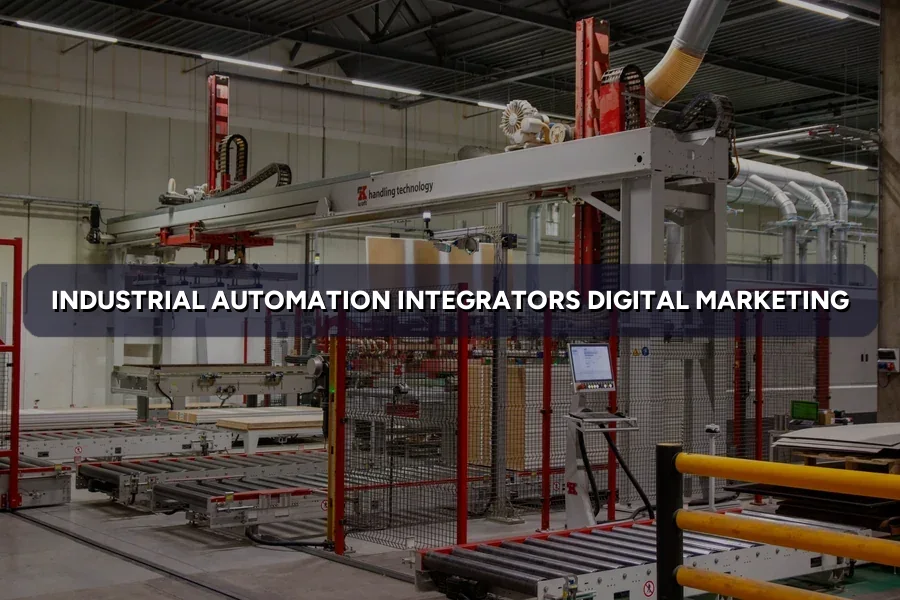
Automation is sold twice. Once to the engineer who wants the line to stop breaking, and again to the finance director who signs for it.
Most integrators market only to the first one. The website lists brands and PLC platforms, the LinkedIn page shows a commissioned cell, and the enquiry form waits. Meanwhile the project that was going to be yours spent four months inside a company you never knew existed, and landed with an integrator whose application page happened to match the plant’s exact problem.
This guide applies the IZI Blueprint, the four-phase method IZI Digital Marketing uses in consulting engagements, to digital marketing for industrial automation integrators in Malaysia. Where the projects are being approved. What a plant manager verifies before calling. How long you must stay visible before a purchase order appears. The video below is a sensible primer on integrator marketing before the Malaysian detail.
How system integrators win more qualified leads online
Source video: Digital Marketing for System Integrators – Land More Leads
PART 2 · THE MARKET
How Big Is Malaysia’s Automation Market Right Now?
IN BRIEFBusy, and broadening. Malaysia approved RM51.3 billion of manufacturing investment across 973 projects in the first half of 2026, with project numbers up 88.2 per cent, which is a wider buyer base than metal fabrication workshops usually see.
Two lines in the latest MIDA investment performance release matter more to an integrator than the headline.
- Project count, not project size. The number of approved manufacturing projects rose 88.2 per cent year-on-year, while the ringgit total fell against an unusually heavy 1H 2025. More projects, smaller each, is exactly the shape of the market that buys integration work.
- Domestic money is moving. Domestic investment in manufacturing grew 23.0 per cent to RM18.6 billion. Malaysian-owned plants are the ones that will phone a local integrator rather than import a turnkey line.
That second point is the one to build marketing around. A multinational fit-out usually arrives with its integrator already chosen overseas. A Malaysian family manufacturer expanding a second line goes looking, and looking now mostly means searching.
PART 3 · DIAGNOSE
How Do Malaysian Manufacturers Choose an Automation Integrator?
IN BRIEFInternally first, externally second. The decision starts as an argument about a bottleneck and only later becomes a search, which is why being findable for application terms beats being findable for your company name.
The sequence is remarkably consistent across plants.
- A line problem becomes unbearable. Labour shortage on night shift, a reject rate nobody can explain, a customer audit that failed on traceability.
- An engineer researches privately. Searching the application, not the technology. Case palletising. Vision inspection for blister packs. Not “system integrator”.
- A shortlist forms from evidence. Who has done this exact application, in a plant that looks like ours, in this country.
- Site visits and a trial. The engineer wants to stand in front of a working cell, ideally yours.
- Finance joins late and changes everything. Payback period, incentive eligibility, and whether the integrator will still exist in year five.
Notice that your marketing is being read at step two, months before any enquiry. If nothing of yours exists on that application, you are not shortlisted at step three and never learn why.
Do you know which applications your buyers search for?
Send us your last ten commissioned projects and we will map each to the terms an engineer would have typed. See how paid search catches an active project
PART 4 · DIAGNOSE
Where Automation Integrators Lose Projects Before the Quote
IN BRIEFSix leaks, and five of them are content problems rather than budget problems. Run this audit before commissioning any technical content work or funding a campaign.
Read your own website the way a production manager under pressure would.
- Brand logos instead of applications. A wall of Siemens, Rockwell and Mitsubishi badges tells a buyer what you buy, not what you solve.
- No project stories with numbers. Cycle time before and after, reject rate, payback in months. Without those, every integrator reads the same.
- Photographs with no plant in them. A rendered robot arm proves nothing. A commissioned cell in a Malaysian factory proves everything.
- Nothing about safety and compliance. Risk assessment, guarding, interlocks. The plant’s safety officer has a veto and you never addressed them.
- Silence on incentives. Your buyer’s business case often depends on a tax allowance you never mention.
- Enquiries answered in days. Engineers shortlist three. The slowest reply is quietly dropped before the meeting.
PART 5 · DESIGN
Which Channel Deserves Your First Ringgit?
IN BRIEFApplication content first, paid search second. A long buying cycle rewards published proof more than it rewards reach, which is the same logic that governs CNC machining services selling to the same plants.
Judge the four realistic options on three things: how quickly the first real enquiry lands, what it costs to keep running, and how well it matches a purchase that takes months to approve.
DECISION BOX · WHERE THE FIRST BUDGET GOES
| Option | Speed to first enquiry | Monthly cost floor | Fit for a long approval cycle |
|---|---|---|---|
| Application content and SEO | Slow, 5–9 months | RM 2,000+ | Highest, it works while you sleep |
| Google Search ads | Fast, 2–4 weeks | RM 3,000+ | Good, but only catches live projects |
| LinkedIn presence | Medium, 2–4 months | Free, costs time | Strong for staying visible mid-cycle |
| Trade shows only | Event-bound | RM 30,000+ per show | Weak alone, nothing between shows |
Verdict: Build four or five application pages first, because they feed every other channel. Add Google Search ads if you need enquiries inside a quarter, and treat trade shows as a way to collect content rather than a channel in their own right.
PART 6 · DESIGN
Setting a Budget From Project Value, Not Turnover
IN BRIEFSize the budget against one project, then against the service revenue that follows it. Percentage-of-turnover rules break badly for integrators, for the same reason they break in any long-cycle consulting business.
Four figures from your own accounts settle it.
- Average contract value. Twelve months of projects, total divided by count.
- Gross margin after hardware and engineering hours. The honest figure, not the quoted one.
- Attached service revenue. Spares, retrofits and support over the cell’s life, which is often where the profit actually sits.
- Engineering capacity. How many concurrent commissions your team can carry without slipping dates.
An integrator averaging RM 350,000 a project at 25 per cent margin earns roughly RM 87,500 per project, before support revenue. Spending RM 5,000 a month to win one additional project a year is comfortably worth it. Spending it while your two commissioning engineers are already fully booked is not.
Bring three numbers and we will size the spend with you
Average contract value, gross margin, and free engineering capacity next quarter. That is enough to stop guessing. See how the same maths shapes an SEO plan
PART 7 · DESIGN
The Proof a Plant Manager Checks Before Calling
IN BRIEFNo single licence makes you an integrator, which is the problem. Credibility is assembled from four separate registrations, much as it is for construction companies, and each belongs in plain sight on your site.
Your website has one job: get a scoped enquiry from a qualified plant. Five things carry most of that weight.
- Company registration stated openly. Your Companies Commission of Malaysia number is what allows a buyer to raise a purchase order at all.
- CIDB registration if you install on site. Registration with CIDB is mandatory under Section 25 of Act 520 before undertaking construction work, and plant fit-out often counts.
- Machinery safety credentials. Any Certificate of Fitness and your risk-assessment practice under the Department of Occupational Safety and Health. Say who signs off your guarding design.
- Electrical competency. Where your scope includes switchboards or power distribution, name the Energy Commission registration your electrical personnel hold.
- Vendor and quality certifications. Platform certifications and ISO 9001 where you hold them, dated and named rather than implied by a logo.
PART 8 · DEPLOY
The First 90 Days, in Sequence
IN BRIEFNinety days is enough to publish real proof and fund one channel properly. Sequence matters far more than effort, which is the principle behind how we advise every industry.
- Weeks 1–2: Diagnose. List last year’s enquiries, their source, how many were quoted, and how long the first reply took.
- Weeks 3–5: Write the application pages. Four or five, each named after a real problem such as end-of-line palletising or vision inspection.
- Weeks 6–7: Add the numbers. Go back to three past clients for permission to publish cycle time, reject rate or payback figures.
- Weeks 8–9: Publish the compliance page. Registrations, safety practice, certifications, and the incentive your customers can claim.
- Weeks 10–11: Fix response time. Name one engineer to acknowledge every technical enquiry within four working hours.
- Week 12: Fund one channel. Take search to its monthly floor behind the new pages, then read the Part 10 numbers before changing anything.
PART 9 · DEPLOY
Local Visibility and the Reference Plant Problem
IN BRIEFResponse speed is a regional advantage, so say where you are. A claimed map listing costs nothing and is the cheapest part of showing up in nearby industrial searches.
Integrators undervalue local search because their projects are national. Buyers do not. Downtime is measured in hours, and a plant in Bayan Lepas would rather call Penang than Selangor.
- Category set to what you actually do. Automation company or engineering consultant, not a generic trading label.
- Service areas named. List the industrial parks and corridors you cover, since that is how response time gets judged.
- Photographs of commissioned cells. With client permission, one working installation outperforms any office photograph.
- Reviews from engineers, not procurement. Two sentences from a maintenance manager about uptime carry more weight than a star rating.
BENCHMARK BRIEFING 1 OF 4
Which Malaysian Industries Are Approving Automation Projects Now?
IN BRIEFFive industries account for 76.9 per cent of approved manufacturing investment. Read as a content plan rather than an economics table, it tells you which application pages to write first and where paid search will find live projects.
| Industry, 1H 2026 | Approved investment | Growth signal | Integration work it usually buys |
|---|---|---|---|
| Electrical and electronics | RM16.6 billion | Largest industry | Test handling, vision inspection, cleanroom transfer |
| Machinery and equipment | RM7.5 billion | Up 44.8% | Machine build, controls retrofit, robot integration |
| Chemicals and chemical products | RM5.5 billion | Steady | Process control, batching, safety instrumentation |
| Transport equipment | RM4.9 billion | Steady | Assembly lines, conveyors, torque and traceability |
| Food manufacturing | RM4.9 billion | Up 40.9% | Packaging, palletising, washdown-rated cells |
| These five together | 76.9% of approvals | 973 projects | Total manufacturing approvals RM51.3 billion |
Aggregated by IZI Digital Marketing from the MIDA 1H 2026 investment performance release. Figures cover all manufacturing approvals, not automation spend alone. Licence.
Machinery and food are the two rows worth acting on. Both are growing above 40 per cent and both buy the kind of mid-sized cell a Malaysian integrator can win outright.
BENCHMARK BRIEFING 2 OF 4
What Government Money Is Funding Your Customer’s Project?
IN BRIEFA 200 per cent allowance on the first RM10 million sits behind many Malaysian automation business cases. Explaining it clearly is among the highest-return pages an integrator can publish, because almost no competitor bothers.
| What the rule says | The detail | Why it changes your proposal |
|---|---|---|
| Size of the allowance | 200% on the first RM10 million of qualifying capex | Payback maths improves sharply once it is included |
| Window | Years of assessment 2023 to 2027; applications close 31 December 2027 | A genuine deadline you can reference honestly |
| Who may claim | Companies incorporated under the Companies Act 2016, trading at least 36 months | Filters which prospects can use the argument |
| Technical condition | At least one item adapting an Industry 4.0 element, such as system integration, autonomous robots or IoT | Your scope wording decides whether it qualifies |
| Who verifies it | MIDA on non-technical grounds, SIRIM on technical grounds, including a site visit | Your documentation becomes part of their claim |
Aggregated by IZI Digital Marketing from the MIDA Automation CA guidelines dated 1 July 2024. Not tax advice. Licence.
The last row is the commercial insight. Because SIRIM verifies the technology, the integrator who writes a clean, claim-ready scope document is materially easier to buy from.
BENCHMARK BRIEFING 3 OF 4
How Long Is an Automation Integrator’s Sales Cycle?
IN BRIEFAround eight months from internal problem to purchase order, on this model. That length is why short campaigns mislead, and why marketing patience matters here far more than it does for a clinic filling next week’s diary.
| Stage | Relative length | Weeks | Cumulative week |
|---|---|---|---|
| Line problem accepted internally | 6 | 6 | |
| Search, shortlist and site visits | 5 | 11 | |
| Scope, trial and proposal | 8 | 19 | |
| Budget, incentive and board approval | 10 | 29 | |
| Purchase order issued | 3 | 32 |
Illustrative model by IZI Digital Marketing, built on MIDA’s stated 18 to 24 month approval-to-implementation cycle. Not measured results. Licence.
The longest bar is the one you cannot sell into. Approval is internal, so the only thing that helps is material your champion can forward to a finance director without you in the room.
Does your marketing survive a 32-week wait?
We will map what a prospect can find about you at each stage, and where the trail goes cold. Plan content for a long buying cycle
BENCHMARK BRIEFING 4 OF 4
Are Approved Projects Turning Into Real Installations?
IN BRIEFMostly yes, and the lag is your opportunity. Of 5,822 manufacturing projects approved since 2021, 87.0 per cent have reached implementation, which makes the approval list a forward view of where the work lands next.
| Approval cohort | Share implemented | Basis | What it means for your pipeline |
|---|---|---|---|
| 2021 to 2024 | Above 90% | MIDA measured | Fit-out largely awarded already |
| 2025 | 83.8% | MIDA measured | Commissioning work running now |
| 1H 2026 | 65.5% | MIDA measured | Your live market, still specifying |
| Under review, 10 August 2026 | Not yet approved | 99 projects, RM35.6 billion | The 2027 and 2028 order book |
| 1H 2026 cohort fit-out window | Projected | Modelled on the 18–24 month cycle | Roughly late 2027 into mid 2028 |
Measured rows from the MIDA 1H 2026 release. The shaded row is modelled by IZI Digital Marketing. Licence.
Hold the shaded row loosely. It says the work exists, not that it will come to you, and the plants approved this year are choosing their integrator right about now.
PART 10 · DRIVE
The Numbers That Tell You It’s Working
IN BRIEFFive figures, read on the same date each month, settle whether digital marketing for industrial automation integrators is paying for itself. The early ones move first; projects won moves last.
| What to read | Why it matters |
|---|---|
| Application page visits | The earliest signal you have. It moves months before any enquiry does |
| Scoped enquiries | Count only those naming a line, a product and a problem. General ones are noise |
| Hours to first response | Measured in hours. It usually explains a poor shortlist rate on its own |
| Proposal-to-win rate | Falling means a proof or pricing problem. More traffic will not repair it |
| Cost per project won | Twelve months of spend divided by projects won. Compare against margin, never contract value |
FAQ
Common Questions About Marketing an Automation Business
1. How much should a Malaysian automation integrator spend on marketing?
Most land between RM 3,000 and RM 8,000 a month. It depends on average contract value rather than turnover, since a single project usually covers a year of spending. Size it so one extra project a year clears the cost several times over.
2. Does SEO work for industrial automation companies in Malaysia?
Yes, and it suits them better than most industries. It depends on publishing real application detail, because engineers search problems rather than company names. Expect five to nine months before enquiries become steady, so plan the budget accordingly.
3. Should I mention tax incentives in my proposals?
Yes, carefully, and never as tax advice. It depends on the client’s profile, since the Automation Capital Allowance requires 36 months of trading and an Industry 4.0 element. Point them to MIDA and let their tax agent confirm eligibility.
4. Is LinkedIn or Google better for automation integrators?
Google first, LinkedIn alongside it. It depends on the stage you are targeting, since search catches an engineer already researching while LinkedIn keeps you visible through months of internal approval. Running only LinkedIn misses the buyers with live projects.
5. Can I publish client projects if they will not be named?
Yes, and anonymised still works. It depends on the numbers surviving, since cycle time, reject rate and payback are what persuade. Describe the industry, the line and the result without the company name, and get written permission first.
THE VERDICT
Your Decision Checklist
Four decisions about digital marketing for industrial automation integrators should now be yours to make.
- Whether your applications are published. Named problems with real numbers attached, not a wall of brand logos.
- Which channel opens the account. Application content first because it compounds, then paid search to catch live projects.
- How long you will fund it. Twelve months, because the buying cycle is roughly eight and a shorter test answers nothing.
- Whether you will talk about the incentive. Your customer’s business case may depend on it, and almost no competitor explains it.
One honest caveat. If your commissioning team is already booked out for nine months, do not hire anyone yet. More enquiries would only lengthen your lead times and cost you the referrals that are currently working.
Not sure whether your problem is visibility or proof?
Take a free Blueprint consultation. We will read your last year of enquiries with you, decide which applications deserve their own page, and hand over a sequenced 90-day plan you are free to run with anyone.