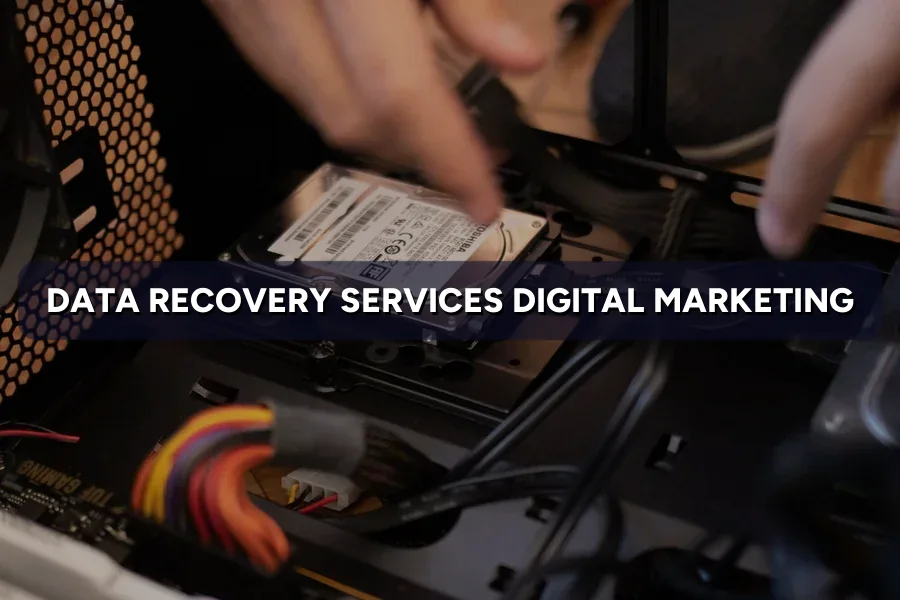
Most advice written for this trade is really advice for a computer shop. It talks about foot traffic, service packages and seasonal promotions. None of that applies when the product is a fear, the buying window is a single afternoon, and no customer can tell a genuine clean room from a tidy back office.
So the strategy question is narrower. A stranger is holding a drive containing four years of accounts or a daughter’s wedding photos. They have already typed the panic into Google once. What would make them hand that drive to you rather than to the shop that quoted RM 300 and promised the world?
This guide applies the IZI Blueprint, the four-phase method we use in consulting engagements, to digital marketing for data recovery services specifically. It carries four original data briefings, including one mapping where the paying jobs actually come from and one settling what an hour of lab time is worth before you spend anything to fill it.
What customers imagine data recovery involves, and what it really is
Source video: Mental Outlaw on how data recovery works
PART 2 · THE MARKET
Where Data Recovery Sits in Malaysia’s Digital Economy
IN BRIEFAlmost every Malaysian business now runs on digital storage, so the pool of potential jobs is enormous while the pool of people searching today is tiny. That gap is why this is a paid search business before it is anything else.
Two official numbers frame the trade. In 2024, 97.2 per cent of Malaysian establishments used computers and 95.3 per cent had internet access, according to the Department of Statistics Malaysia’s Usage of ICT and E-Commerce by Establishment release. On the loss side, MyCERT recorded 51 ransomware incidents reported to Cyber999 during 2025 and 171 data breach reports in the fourth quarter alone, in its Cyber Incident Quarterly Summary Report.
Three things follow for an operator:
- Demand exists but cannot be created. No advert persuades someone to lose a drive. You compete for a fixed stream of accidents, so visibility at the moment of panic is the entire game.
- Reported incidents are the visible tip. Most business data loss is a failed disk or a deleted folder that nobody reports to anyone. Treat the official counts as a floor, not a market size.
- The valuable jobs are not consumer jobs. A student’s laptop pays for the day. A failed NAS at a manufacturing SME pays for the month, and it usually arrives through somebody else’s technician.
PART 3 · DIAGNOSE
How Do Malaysians Actually Look for Data Recovery?
IN BRIEFThe search happens after a failed DIY attempt, not before it, which means you meet the customer at their second decision rather than their first. Reading that sequence properly is what separates this from an ordinary local search exercise.
Five moments, in order, each with a different decision-maker:
- The failure, then the fiddling. Most people run free software first. Every one of those hours makes your job harder.
- The first search, on a phone. Broad and desperate: “hard disk cannot detect”. They are hunting a free fix, not you.
- The realisation it is beyond them. The query turns commercial, modified by “near me” or the brand of the failed device.
- The price sanity check. They message three shops on WhatsApp and quietly discard whoever will not name a number.
- The handover. Awkward and full of doubt. Whoever explained the diagnostic step most calmly gets the drive.
Two neighbouring trades meet that customer before you do. Phone and computer repair shops hold the walk-in moment, and IT support providers hold the business accounts where the serious money sits.
Not sure whether your jobs come from search or from referrals?
Most labs have never separated the two, so they keep funding the smaller one. See how we split enquiry sources
PART 4 · DIAGNOSE
Where Data Recovery Firms Leak Enquiries
IN BRIEFJobs are lost to vagueness and delay, almost never to a cheaper rival. Run this audit before you spend a ringgit, exactly as we would in the diagnosis stage for any of the businesses we serve.
Each line below is either true of your business or it is a leak:
- No price anywhere on the site. A frightened customer reads silence as “this will be thousands”, and messages the shop that published a band.
- The diagnostic step is not explained. If nobody understands what happens between handover and quote, the handover does not happen.
- No success-rate honesty. Claiming you recover everything reads as a lie to anyone already told no once.
- Slow WhatsApp replies. This is a same-afternoon purchase. A two-hour reply is a lost job, not a late one.
- Nothing addressed to IT firms. No trade page, no white-label terms, no promise you will not poach their client.
- No named privacy position. You are asking strangers to hand over their digital life and saying nothing about how it is handled.
Fix the price band, the diagnostic explanation and the reply speed first. All three cost nothing.
PART 5 · DESIGN
Which Channel Deserves Your First Ringgit?
IN BRIEFFor almost every lab the first ringgit belongs to Google Search on emergency terms, and the second to an IT-firm referral programme. Social advertising sits last, because you cannot advertise into a loss that has not happened yet.
Judge the four realistic options on three things: how fast the first job arrives, the monthly cost of keeping the channel alive, and whether it reaches somebody at the moment they decide.
DECISION BOX · FIRST CHANNEL FOR A DATA RECOVERY LAB
| Option | Speed to first job | Monthly cost floor | Reaches the panic moment |
|---|---|---|---|
| Google Search Ads on emergency terms | 2–5 days | RM 1,500+/mo | Strongest — exact moment |
| IT firm and repair shop referrals | 3–8 weeks | RM 0 + commission | Strong — highest job value |
| Organic search and technical content | 4–8 months | RM 2,000+/mo | Good — compounds, slowly |
| Meta Ads to consumers | Unpredictable | RM 900+/mo | Weak — wrong timing entirely |
Verdict: Start with Google Search Ads if your lab has idle capacity this month, since it is the only channel that arrives at the failure itself. Build the referral layer in parallel because it costs nothing but visits. Add organic search once paid search is profitable, and treat Meta Ads as a later brand-memory play.
PART 6 · DESIGN
Setting a Budget From Your Own Job Numbers
IN BRIEFBudget from spare bench hours and your real no-data-no-fee failure rate, not from a package tier. If the bench is already full, marketing is not your constraint and what each budget level buys is the wrong question to be asking.
Work four numbers in order:
- Spare bench hours. Lab hours you could sell this month but will not. That idle figure is your entire justification for spending.
- Average recovered-job value. Not the headline price, but the realistic fee after the discounting that follows a quote landing badly.
- Your failure rate. Under no-data-no-fee, some jobs eat bench time and return nothing. Ten diagnostics yielding six paid recoveries puts your true cost per job forty per cent above what it looks.
- Affordable cost per job. Twelve to twenty per cent of gross margin on the first job is defensible while capacity sits idle. Below that you underfund; above it you buy revenue at a loss.
Want a second opinion on the capacity maths?
Bring last quarter’s job log and we will work out what an idle bench hour is really costing you. Talk it through with a consultant
PART 7 · DESIGN
What a Data Recovery Lab Must Prove Online
IN BRIEFThere is no data recovery licence in Malaysia, so your data-handling position becomes your licence. Build the website around one action, a WhatsApp message with a photo of the drive, and put the privacy paperwork where a doubting customer will find it.
The regulation that matters is not about your trade, it is about the files. Anyone handling customers’ personal data sits under the Personal Data Protection Act 2010, now reshaped by the Personal Data Protection (Amendment) Act 2024. Since 2025 it has carried duties for data processors, mandatory breach reporting under the Commissioner’s data breach notification guidelines, and data protection officer requirements for qualifying organisations. Verify your own position before publishing any claim.
Five things carry the trust load:
- State your PDPA position plainly. Who accesses the files, how long they are kept, how they are destroyed. No legal boilerplate.
- Describe the diagnostic step by step. Intake, imaging, assessment, quote. This page converts more doubting customers than any testimonial.
- Publish honest success bands by failure type. Logical deletion, firmware fault, physical head crash. Ranges, not promises.
- Offer an NDA and say so. Corporate and legal work will not come to a lab that has never mentioned one.
- Show the actual bench. Photographs of your own equipment. Stock imagery of a gloved hand in a blue clean room reads as concealment.
PART 8 · DEPLOY
The First 90 Days, in Sequence
IN BRIEFDeploy in order: proof, then listing, then paid search, then the trade channel. Running them together leaves you unable to say which one filled the bench, the same sequencing problem faced by network cabling contractors selling to the same buyers.
How to launch data recovery marketing in 90 days
This assumes one lab, two engineers and no marketing staff. Each stage must hold before the next begins.
- Weeks 1–2: publish the proof. The diagnostic page, price bands by job type, honest success ranges, your PDPA and NDA position, and a WhatsApp number a human watches.
- Weeks 3–4: complete the listing. Claim the Google Business Profile, set real hours, add photographs of your own bench, and list each service separately.
- Weeks 5–8: switch on paid search. Emergency device-failure terms only, tight geography, and a landing page answering price and process above the fold.
- Weeks 9–12: build the trade channel. Visit IT support firms, repair shops and camera dealers with a trade sheet, white-label terms and a written promise never to approach their client.
PART 9 · DEPLOY
Google Business Profile and Reviews for Data Recovery
IN BRIEFThe listing is where a nervous customer verifies you between the advert and the handover, so treat it as the trust layer rather than a directory entry. It is worth setting up once, slowly, in-house.
Four decisions carry most of the value:
- Photographs of your real equipment. Customers are checking whether you look like a lab or a shopfront with a screwdriver.
- Every service listed separately. RAID recovery, SSD recovery, phone data extraction. Each one is a different search and a different price expectation.
- Ask for the review at collection. When the customer is holding the replacement drive with their files on it, not by automated message a week later.
- Answer failed-recovery reviews once, factually. Explain what was attempted and stop. Defensive threads do more damage than the original review.
Reviews that describe the diagnostic honesty are worth several that say “fast service”. Ask reviewers what reassured them before they handed the drive over.
Selling to businesses as well as walk-ins?
The B2B half of this trade behaves nothing like the consumer half, and it rewards patience differently. Compare how longer B2B cycles are worked
BENCHMARK BRIEFING 1 OF 4
Where Do Data Recovery Jobs Actually Come From?
IN BRIEFWe mapped five routes a job arrives by, and who holds the decision on each. Two routes carry most of the revenue and neither of them is the panicking device owner, which is where IZI Digital Marketing would start the first campaign.
| Route in | Who really decides | Typical job value (RM) | What wins it |
|---|---|---|---|
| IT support firm escalates a server or NAS | The IT provider | 1,200–6,000 | A written promise never to approach their client |
| Corporate, legal or insurance instruction | Procurement or a solicitor | 3,000–20,000 | Chain of custody and a written report |
| Direct search after a failed DIY attempt | The device owner, alone | 450–1,800 | A visible price band and a fast reply |
| Repair shop hands the drive over | The technician at the counter | 600–2,500 | Same-day collection and a clear margin for them |
| Past customer or word of mouth | Someone already convinced | 400–1,500 | Being findable under the same name years later |
Illustrative model by IZI Digital Marketing, built on the published service structure and price bands of Malaysian data recovery providers. Licence.
The two highest-value routes are decided by a professional, not a panicking owner. Fund those relationships even while paid search pays the bills.
BENCHMARK BRIEFING 2 OF 4
What Stops a Customer From Handing Over the Drive?
IN BRIEFWe modelled the objection that ends the conversation. Doubt about the outcome beats doubt about the price, which should decide the order of your landing page more than any bidding tactic will.
| The objection | Share of lost enquiries | % | The counter-move |
|---|---|---|---|
| Can you even recover it? | 28 | Published success bands by failure type | |
| How much, before you open it? | 24 | Fixed diagnostic fee and a quote ceiling | |
| Will someone read my files? | 19 | A named PDPA position and an NDA on request | |
| How long will it take? | 17 | Stated turnaround tiers and an emergency lane | |
| Must I travel to your office? | 12 | Insured courier pickup, priced openly |
Illustrative model by IZI Digital Marketing, built on the published FAQ and pricing structure of Malaysian data recovery providers. Licence.
Answer the first two above the fold. A page that opens with equipment photographs has answered neither.
BENCHMARK BRIEFING 3 OF 4
What Is a Data Recovery Job Actually Worth?
IN BRIEFWe modelled six job types against the bench hours each consumes. RAID work carries the lab, and the gap between job types should set both your bidding and what you can afford to spend winning each one.
| Job type | Fee band (RM) | Bench hours | RM per hour | Affordable cost per job |
|---|---|---|---|---|
| Logical recovery, single drive | 350–800 | 2.0 | 175–400 | 45–95 |
| Physical hard disk recovery | 900–2,500 | 6.0 | 150–415 | 110–300 |
| SSD or NVMe chip-level work | 1,200–3,500 | 8.0 | 150–440 | 140–400 |
| RAID or NAS rebuild | 2,500–9,000 | 14.0 | 180–645 | 300–1,000 |
| Mobile phone data extraction | 600–1,800 | 4.5 | 135–400 | 70–210 |
| Diagnostic that ends in no recovery | 0 | 1.5 | 0 | A cost of sale, not a job |
Illustrative model by IZI Digital Marketing, built on published Malaysian data recovery price bands and typical lab turnaround times. Licence.
Substitute your own prices. The shape rarely changes: RAID work carries the month, and the unpaid diagnostics quietly eat the margin.
BENCHMARK BRIEFING 4 OF 4
Which Devices Will Malaysian Labs Be Recovering in 2027?
IN BRIEFThe device mix is shifting away from spinning disks towards flash storage, which changes both your training budget and the keywords worth owning. Labs that ignore this end up ranking well for a shrinking job type.
| Device category | 2023 share (%) | 2025 share (%) | 2027 projected (%) | What it changes |
|---|---|---|---|---|
| Spinning hard disk | 46 | 34 | 24 | Clean-room work shrinks as a share of revenue |
| SSD and NVMe | 18 | 27 | 35 | Chip-level skill becomes the growth investment |
| Mobile phone and tablet | 15 | 19 | 22 | High volume, modest value, strong referral source |
| NAS, RAID and server | 14 | 15 | 14 | Flat share, rising value per job |
| Memory cards and camera media | 7 | 5 | 5 | A long tail worth one page, not a campaign |
Modelled projection by IZI Digital Marketing on Malaysian storage adoption trends — not measured results. Licence.
Point next year’s content and bidding at flash storage. The hard disk pages will keep earning, but they will not keep growing.
PART 10 · DRIVE
The Numbers That Tell You It’s Working
IN BRIEFTrack five numbers monthly and ignore the rest. Enquiry count flatters you, so judge digital marketing for data recovery services by quote acceptance and what each source really costs.
Review these on the first working day of each month:
- Cost per recovered job by source. Split paid search, trade referral and organic, then compare against the affordable figure from Part 6.
- Quote acceptance rate. The share of diagnostics that become paid recoveries. Falling acceptance usually means slow quotes, not high ones.
- Active referring partners. IT firms and repair shops that sent a job in ninety days. This predicts next quarter better than any traffic report.
- Average job value. If it slides while volume rises, paid search is buying consumer phone work at RAID prices.
- First-reply time in working hours. Minutes to a human answer on WhatsApp. Sample one week honestly.
Set the stopping rule before you spend. Two consecutive months above your cost ceiling and the paid channel pauses while you re-diagnose.
FAQ
Frequently Asked Questions
1. Do you need a licence to run a data recovery business in Malaysia?
No specific licence exists for the trade itself. It depends on what you handle, though: because you process customers’ personal data, the Personal Data Protection Act 2010 and its 2024 amendments apply, so confirm your data controller or processor position before you advertise anything.
2. How much should a data recovery lab spend on digital marketing?
More than most owners expect, because search competition here is expensive. It depends on idle bench capacity rather than revenue: with the website and listing done, RM 1,500 to RM 4,000 a month is a realistic Klang Valley starting range.
3. Is Google or Facebook better for data recovery marketing?
Google, and it is not close. It depends on your goal, though: search captures someone whose drive failed this morning, while Facebook can only build recognition for a disaster nobody believes will happen to them.
4. How long before data recovery marketing brings in jobs?
Two to five days on paid search, and six to eight weeks through trade referrals. It depends on your service range: a lab handling RAID and SSD work sees movement quickly, while a consumer-only shop competes on price from day one.
5. What is the strongest trust signal for a Malaysian data recovery lab online?
A plainly written, step-by-step explanation of the diagnostic process with honest success bands. It depends slightly on your market, but this answers the doubt most customers are too embarrassed to voice, and no testimonial substitutes for it.
THE VERDICT
Your Decision Checklist
Digital marketing for data recovery services comes down to four decisions you should now be able to make without another meeting:
- Which half of the market you are funding. Consumer panic pays daily through paid search; professional referrals pay monthly through visits. Most labs need both, in that order.
- What your landing page answers first. Can you recover it, then what it costs, then who touches the files. Anything else is out of order.
- Whether your quotes move fast enough. A quote arriving tomorrow has already lost to one that arrived in twenty minutes.
- What would make you stop spending. Write the ceiling down before the first campaign runs. The businesses we advise that set it early stay calm in month two.
One honest caveat. If the bench is already full and quotes are accepted faster than you can clear them, marketing is not your constraint. Raise the emergency-lane price, hire a second engineer, and revisit this when the schedule shows gaps.
Not sure which of these moves fits your recovery lab?
Book a free Blueprint consultation — we’ll diagnose where your enquiries leak, design the search and referral decisions around your own bench capacity, and hand you a sequenced 90-day plan you can run with anyone.