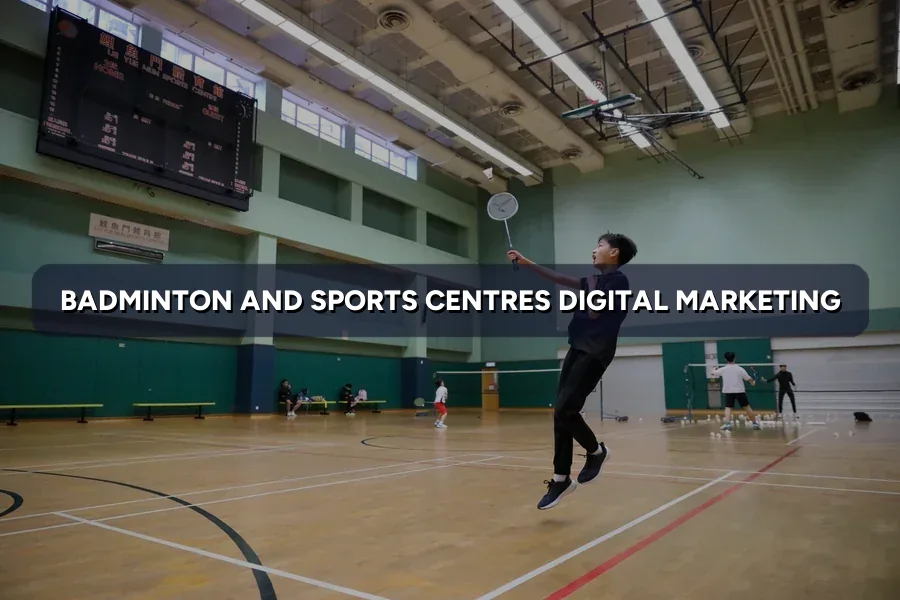
Two facts sit in every Malaysian sports centre, and they are rarely put side by side.
The first: Friday at 9pm is booked out a week ahead and people still ring asking. The second: on a Tuesday at half past ten, eight courts are lit, the fans are turning, the rent is being paid, and two are in play.
Nobody markets the second fact, because the phone is busy with the first. Yet that is where the money is. Your stock is a court-hour, and an hour you have not sold by the time it starts is gone for good — the same perishability an airline seat has. This guide applies the IZI Blueprint, the four-phase method we use in consulting engagements, to a Malaysian centre: who really makes the booking, where the first ringgit belongs, what your licence and website must show, and the figures that tell you it is working. The video below sets out the court-business economics first.
What actually drives the economics of a court business
Source video: Starting My Own Business | Badminton, Tennis and Pickleball
PART 2 · THE MARKET
What Malaysia’s Numbers Say About the Sports Business
IN BRIEFSport is now a measured RM19.6 billion industry in Malaysia, and the operator’s slice of it is the largest one. Those official figures matter more to your pricing than any fitness trend, as they do across the industries we advise.
Three published figures set the floor under this guide.
- Sport is big, and properly counted. The Department of Statistics Malaysia Sport Satellite Account 2022 records output of RM49.5 billion and value added of RM19.6 billion — 1.1 per cent of GDP.
- Services lead it. Sport services, which covers facilities and coaching, made up RM7.3 billion of that and grew 15.9 per cent in one year.
- Your customers are at work. The Labour Force Survey 2025 puts participation at a record 70.8 per cent, with 16.58 million people employed.
PART 3 · DIAGNOSE
How Do Malaysians Actually Book a Court?
IN BRIEFOne person books for eight. Nobody turns up alone, so unlike a gym membership the sale is made by an organiser and simply attended by everyone else. Win the organiser and you have won a court-hour for years.
That one fact reorders where your money belongs.
- The group exists first. Office colleagues, a surau committee, a school parents’ chat. Demand forms long before anyone searches.
- Someone gets volunteered. Usually the most organised member, rarely the best player. This is your real customer.
- A map search, then a screenshot. Court near me, badminton Kelana Jaya, futsal PJ. Your rates get pasted into the group chat.
- The group picks a night. Price matters less than whether a court exists on the one evening everyone is free.
- It becomes a standing slot. Same court, same hour, weekly. Nobody re-shops unless something goes wrong.
Where does your centre lose the organiser?
We map those five steps against your own booking flow and show you the exact point people drop out. Meet IZI Digital Marketing
PART 4 · DIAGNOSE
Where Sports Centres Lose Bookings
IN BRIEFSix leaks explain most of the loss, and four cost nothing to plug. Futsal centres leak in the same places, since both sell a perishable hour to the same kind of organiser.
Test each one on your own phone tonight, pretending you have never heard of the place.
- Availability is invisible. If Thursday’s free hours can only be learnt by ringing during office hours, midnight bookers go elsewhere.
- Rates are not published. This is why an organiser opens three tabs instead of one, and it is the cheapest leak to close.
- Nobody answers after 10pm. Your busiest booking hour is the hour your counter is shut.
- Quiet hours are a secret. Your page shows the packed Friday night. The empty Tuesday morning is something you pay rent to hide.
- No deposit, so no commitment. Phone bookings without payment breed no-shows, and a no-show is an hour you also turned others away from.
- Lapsed groups go unnoticed. A standing slot quietly stops in week nine and nobody rings to ask why.
PART 5 · DESIGN
Which Channel Deserves Your First Ringgit?
IN BRIEFYour map listing and a bookable timetable come first, because a court is chosen by postcode and by hour. Facebook and Instagram advertising earns second place once you have a named off-peak product to sell.
Four options want the budget in sports marketing in Malaysia. Four tests tell them apart: how quickly a paid booking lands, what each needs at minimum, whether it can shift weekday mornings at all, and what remains once you stop funding it.
DECISION BOX · FIRST CHANNEL FOR A SPORTS CENTRE
| Option | Speed to first booking | Monthly floor | Moves weekday mornings | Survives if you stop paying |
|---|---|---|---|---|
| Business Profile and reviews | 2–5 weeks | RM 0–300 | Partly | Yes |
| Online booking with published rates | 1–3 weeks | RM 100–400 | Yes, best fit | Yes |
| Paid social on an off-peak offer | Days | RM 800+ | Only if the ad names the hour | No |
| Search ads on “court near me” terms | 1–2 weeks | RM 1,000+ | No | No |
Verdict: Take the two free-or-cheap options first, since a listing and a booking page keep working after the month ends. Bring in paid social once a named off-peak product exists, and hold Google Search advertising back for a new branch whose listing has no history.
PART 6 · DESIGN
Setting a Budget From Empty Court-Hours
IN BRIEFBudget from unsold hours and group lifetime value, never from turnover. Pilates studios face the same capacity maths, except they sell to one person at a time rather than to a group of eight.
A share-of-revenue rule breaks down here. A full Friday night earns nothing extra however hard you push it, while an empty Tuesday morning still burns rent, lighting and staff. Work through the numbers in this order.
- Unsold court-hours a week. Courts times opening hours, minus hours sold. This is the only thing marketing can buy.
- Years a group stays. Read it off your booking history. Two years is common, five is excellent.
- Value of one group. Two hours a week at RM30 is RM3,120 a year, so a three-year group is worth RM9,360.
- Affordable cost to win one. Around 10 per cent of that value, so roughly RM930 a group.
- Monthly ceiling. Groups you need, times RM930, spread over the months it will take to land them.
Bring three numbers and we will size the ceiling with you
Hours sold last week, your real blended rate, and how long your oldest standing group has been coming. See how local search fits the same maths
PART 7 · DESIGN
Your Licence, Your Website and What a New Group Checks
IN BRIEFA private sports centre is licensed by its local council, and that licence is your one hard credential. Everything else has to be shown rather than claimed, the way GP clinic websites have to evidence their standards.
Your site has a single job: show a free hour and a price within a minute, on a phone, at night.
- Live availability with a pay button. Readable as text, accurate, and payable on the spot. A deposit at booking removes most no-shows.
- Both rate cards on the page. Peak and off-peak, side by side. Hidden pricing costs you the comparison every time.
- Your council business licence. Private sports centres are a category of their own — Petaling Jaya City Council lists them among the premises it licenses on its business licensing page, and conditions differ by council.
- Real photographs of your courts. Flooring, lighting and ceiling height are what an experienced player judges, and no stock photo shows them.
- Parking, with a number. In the Klang Valley this settles bookings for a group arriving in six cars.
- Public liability cover, stated once. Corporate and school organisers will ask, so answer before they do.
PART 8 · DEPLOY
The First 90 Days, in Sequence
IN BRIEFTwo weeks diagnosing, two designing, then the free foundations and one invented off-peak product before you pay for reach. The order matters more than the tools, which is equally true of organic search work.
How to roll out digital marketing for a sports centre in 90 days
Work through these in order.
- Weeks 1–2: Diagnose. Run the Part 4 test. Chart last quarter’s bookings hour by hour and list every standing group by start date.
- Weeks 3–4: Design. Choose a channel from the Decision Box, set the ceiling from unsold hours, and pick one quiet band to attack.
- Weeks 5–6: Build the free foundations. Claim the listing, put availability and both rate cards online with payment attached, and shoot the courts under match lighting.
- Weeks 7–8: Invent the off-peak product. Give the dead hours a name, a price and a buyer — a morning seniors session, a corporate lunch league, a school holiday clinic.
- Weeks 9–10: Recruit organisers. Approach three offices, a school and a residents’ committee within four kilometres with a written standing-booking rate.
- Weeks 11–12: Deploy one paid channel. Fund it to its floor, point every advert at the named product, then use the Part 10 figures to scale, hold or stop.
PART 9 · DEPLOY
Google Business Profile and Reviews for a Sports Centre
IN BRIEFCourts are bought by postcode, so the listing carries most of badminton centre marketing. Keep it in-house, update it weekly, and let it feed the local search visibility your rates page was built to earn.
Read Google’s guidelines for representing your business before you edit anything. Owners routinely trip them, and a suspended listing hurts more than a paused campaign.
- Name the centre only. Stuffing “Badminton Court Puchong” into the name field risks suspension; the category carries the sport.
- Give every sport its own service entry. Badminton, futsal, pickleball and basketball draw different organisers.
- Put both rate cards in the services section. It answers the first question before it is asked.
- Post the week’s free hours each Monday. Quick to do, and it is what people are actually hunting for.
- Ask the organiser for the review. Eight weeks of bookings gives her something concrete to write.
- Prompt reviewers to mention flooring, lights and parking. Those are the words your next organiser will type.
BENCHMARK BRIEFING 1 OF 4
Where Does the Money in Malaysian Sport Actually Sit?
IN BRIEFMalaysia’s first Sport Satellite Account, read as a business map rather than an economics report. The last column is the useful one, applying the operator lens we bring to every industry we advise.
| Segment, 2022 | Value added | Share | What it means for an operator |
|---|---|---|---|
| Sport services | RM7.3b | 37.1% | Facilities and coaching — your segment, and the largest |
| Sport trade | RM6.9b | 35.2% | Shuttles, stringing, shoes — margin most centres leave alone |
| Manufacturing of sport products | RM5.2b | 26.6% | Not your business, but it supplies the retail you could sell |
| Construction of sport infrastructure | RM0.2b | 1.1% | Almost nothing new is being built; existing courts are scarce |
| Whole sport industry | RM19.6b | 1.1% of GDP | Employs 194,400 people, 1.3% of Malaysian jobs |
Aggregated by IZI Digital Marketing from the Department of Statistics Malaysia Sport Satellite Account 2022. The operator column is IZI’s own reading. Licence.
Trade sits almost level with services, yet most centres run the pro shop as a favour to members rather than a second income line attached to the same court-hour.
BENCHMARK BRIEFING 2 OF 4
Why Are the Courts Empty Before 6pm?
IN BRIEFA modelled demand curve across a 103-hour trading week. Forty of those hours run at under a fifth of peak, which is why a broad search advertising budget aimed at everybody wastes most of itself.
| Time band | Demand against the evening peak | Index | Hours a week |
|---|---|---|---|
| Weekday 8am–12pm | 12 | 20 | |
| Weekday 12pm–4pm | 18 | 20 | |
| Weekday 4pm–6pm | 40 | 10 | |
| Weekend 9am–6pm | 62 | 18 | |
| Weekend 6pm–11pm | 92 | 10 | |
| Weekday 6pm–11pm | 100 | 25 |
Illustrative model by IZI Digital Marketing, built on Malaysian working and school hours and a 70.8 per cent labour force participation rate. Not measured results. Licence.
The two shaded bands carry the argument. Forty hours a week are pointed at someone sitting at a desk, and no price change reaches that person. Only a different buyer does.
BENCHMARK BRIEFING 3 OF 4
What Can an Eight-Court Centre Earn in a Month?
IN BRIEFA modelled utilisation ladder for eight courts open sixteen hours a day. Read the group column rather than the revenue column — it shows how small the gap really is, and how modest your paid social budget can stay.
| Utilisation | Court-hours sold a month | Regular groups needed | Monthly revenue | Marketing ceiling |
|---|---|---|---|---|
| 35 per cent | 1,344 | 155 | RM34,944 | RM3,500 |
| 45 per cent | 1,728 | 200 | RM44,928 | RM4,500 |
| 55 per cent | 2,112 | 245 | RM54,912 | RM5,500 |
| 65 per cent | 2,496 | 285 | RM64,896 | RM6,500 |
| 75 per cent | 2,880 | 330 | RM74,880 | RM7,500 |
Illustrative model by IZI Digital Marketing, built on eight courts, 16 opening hours daily, a blended RM26 an hour and a group booking two hours weekly. Not measured results. Licence.
Getting from 55 to 65 per cent takes roughly 40 more standing groups. Forty organisers is small enough to reach by knocking on doors, which is why the door-knocking comes before the campaign.
Your own booking sheet will tell a sharper story than this model
Send us hours sold by band and we will rebuild the ladder around your real rate card. See how we turn that into a content plan
BENCHMARK BRIEFING 4 OF 4
Is Malaysia’s Sports Industry Still Growing?
IN BRIEFThe industry grew 12.1 per cent in one measured year. Halve that for a projection and the market still outpaces new court building, which favours operators holding durable local visibility rather than renting it.
| Year | Gross value added of the sport industry | Amount | Basis |
|---|---|---|---|
| 2021 | RM17.5b | Derived from the published growth rate | |
| 2022 | RM19.6b | DOSM measured, up 12.1 per cent | |
| 2026, projected | RM24.7b | Modelled at six per cent a year | |
| 2028, projected | RM27.8b | Modelled at six per cent a year |
Derived by IZI Digital Marketing from the Department of Statistics Malaysia Sport Satellite Account 2022. Shaded rows are modelled at half the measured 2022 growth rate. Not measured results. Licence.
Treat the shaded rows as direction, not forecast. Demand is climbing while construction of sport infrastructure sits at barely 1 per cent of the industry, and that scarcity rewards whoever is easiest to find and easiest to book.
PART 10 · DRIVE
The Numbers That Tell You It’s Working
IN BRIEFFive figures, read on the same date each month, tell you whether sports centre marketing pays for itself. Weekday daytime utilisation leads them all, and the review cadence is the one we run with clients in every sector.
| KPI | Where to read it | Change-of-course trigger |
|---|---|---|
| Utilisation, weekdays 8am to 4pm | Booking system, by hour | Under 20% for six weeks |
| Hours held by recurring groups | Repeat bookings as a share of hours | Below half for two months |
| Cost per new recurring group | Spend divided by new standing bookings | Above the Part 6 ceiling twice running |
| Years a group keeps its slot | Booking history by first booking date | Falling for two quarters |
| Bookings completed without a call | Online bookings as a share of total | Below half after three months |
Enquiry counts flatter a centre that is standing still. If enquiries climb while daytime utilisation holds flat, you are paying twice for the same evening booker and squeezing out the standing groups who cover your rent.
FAQ
Common Questions About Sports Centre Marketing in Malaysia
1. How much should a Malaysian sports centre spend on marketing each month?
Most single-site centres land between RM800 and RM3,500 a month. It depends on how many court-hours go unsold, since paying for a Friday night that already fills simply displaces groups who pay you weekly. Size it from roughly 10 per cent of a standing group’s lifetime value.
2. Does a sports centre in Malaysia need a licence?
Yes, a business premises licence from your local council. It depends which council you fall under, as private sports centres usually sit in their own category with conditions on fire safety, parking and signage. Saying on your site that you hold one settles a question corporate and school organisers always raise.
3. Should a sports centre publish its court rates online?
Publish the peak and the off-peak rate together. It depends how many sports you run, but hidden pricing is the main reason an organiser compares three centres instead of booking yours. A visible off-peak figure also sells the hours you most need filled.
4. How do I fill weekday morning and afternoon courts?
Look for a buyer who is free at eleven rather than a lower price. It depends on your neighbourhood, though retirees, shift workers, home-schooling families, students and nearby office teams all qualify. Those hours need their own product name and usually a direct approach, not an advert.
5. Is Google Business Profile or Facebook better for a badminton centre?
Begin with the Business Profile, because courts are searched for by location. It depends what you are selling, though: the listing catches people already hunting a court tonight, while paid social is better at creating demand in an hour nobody thinks to search for.
THE VERDICT
Your Decision Checklist
Four decisions about digital marketing for badminton and sports centres should now be yours to make.
- Which channel opens the account. Listing and online booking with published rates, settled before any media money moves.
- What your monthly ceiling is. A figure produced by your unsold hours and group lifetime value, not a package tier from a proposal.
- Which hours the spend is really buying. One named off-peak band with a product and a buyer attached to it.
- The evidence that would stop you. Agreed in advance, with daytime utilisation ranked above enquiry volume.
One caveat worth saying plainly: if your courts are already running above 75 per cent across the full week, hold off on hiring anyone. Lifting your peak rate or opening an extra hour at each end of the day will earn more, faster, than advertising a building with nothing left to sell.
Not sure which of the four to decide first?
Take a free Blueprint consultation. We will read your booking sheet with you, put a number on the ceiling, and hand over a 90-day sequence you are free to run with anyone.